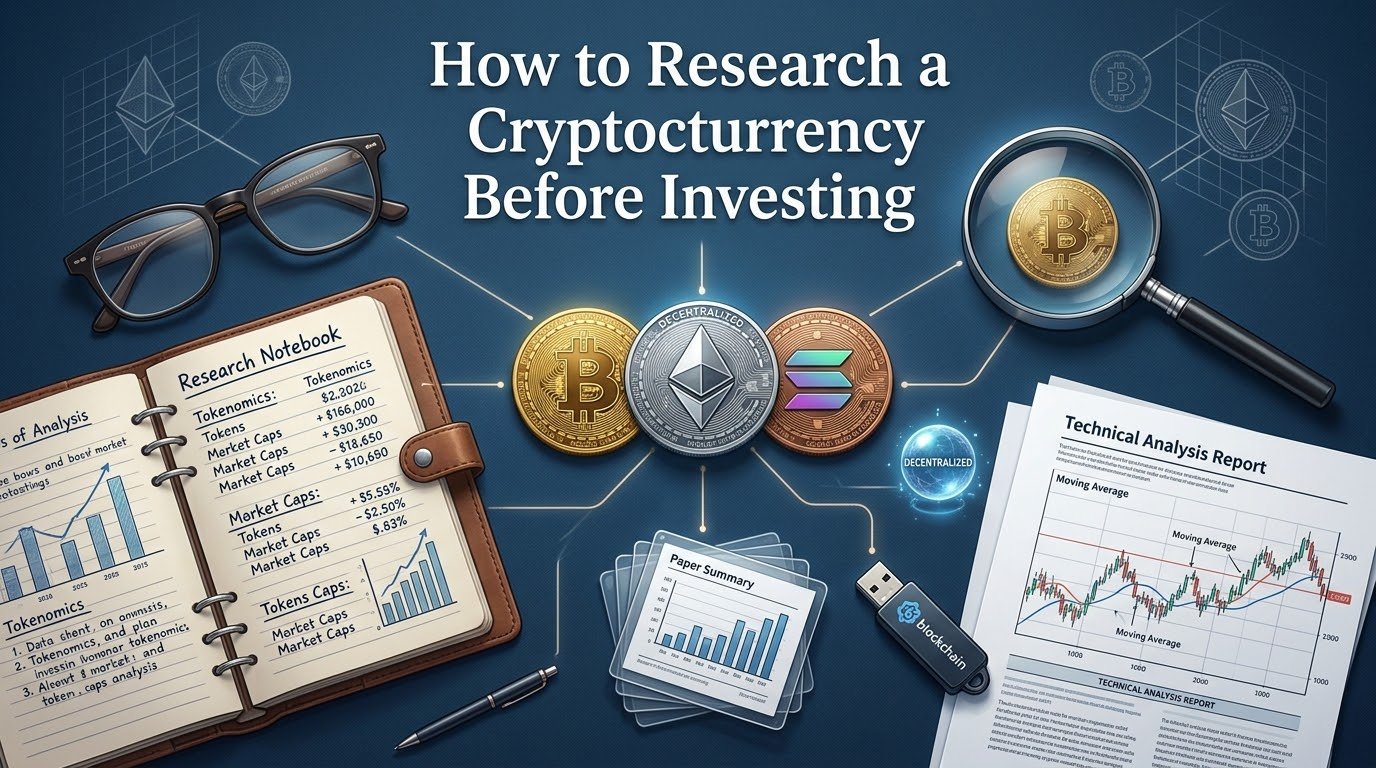
Cryptocurrency can create exciting opportunities, but buying a coin simply because its price is going up—or because someone on social media says it will “10x”—can be extremely risky.
Successful crypto research is not about predicting the future with certainty. Instead, it is about collecting reliable information, understanding the project, evaluating risks, and making decisions based on evidence rather than emotions.
Before investing in any cryptocurrency, you should understand what the project does, why its token exists, how its ecosystem works, who is behind it, how its token supply is structured, and whether there is genuine demand for the project.
In this beginner-friendly guide, we will explain exactly how to research a cryptocurrency before investing.
🧠 Why Crypto Research Matters
The cryptocurrency market contains thousands of coins and tokens.
Some projects may provide useful technology or services, while others may have limited utility, weak economics, anonymous teams, or extremely speculative valuations.
A coin can become popular because of:
- 📱 Social media hype
- 🐸 Meme culture
- 📈 Short-term price increases
- 🗞️ News
- 🤝 Celebrity promotion
- 💰 Exchange listings
- 🎁 Token incentives
- 🚀 Marketing campaigns
But popularity does not automatically mean quality.
Before buying a cryptocurrency, ask yourself:
What am I actually buying, and why might people want this asset in the future?
That question is the foundation of good crypto research.
🔎 Step 1: Understand What the Cryptocurrency Does
The first thing to investigate is the project’s purpose.
Read the project’s official website and documentation.
Try to explain the project in one or two simple sentences.
For example:
“This project provides infrastructure for decentralized applications.”
or:
“This token is used within a blockchain ecosystem for transaction fees and network participation.”
If you cannot explain what the project does, you probably should not invest in it yet.
Questions to Ask
- What problem does the project solve?
- Who is the target user?
- Why does the project need blockchain technology?
- What makes it different?
- Does the token have a purpose?
- Is there actual demand for the product?
- Is the project solving a real problem or simply creating another token?
A complicated whitepaper does not automatically mean a project is valuable.
📄 Step 2: Read the Whitepaper
A whitepaper is a document explaining a project’s technology, goals, economics, and design.
You don’t necessarily need to understand every technical detail.
Instead, look for the major ideas.
Check for:
- Project purpose
- Technology
- Token utility
- Token supply
- Distribution
- Governance
- Roadmap
- Security model
- Development plans
- Potential use cases
🚩 Warning Sign
Be cautious if a whitepaper:
- Makes unrealistic promises
- Guarantees profits
- Uses excessive technical language without explaining the actual product
- Contains copied material
- Provides little information about token economics
- Focuses more on price than technology
A professional-looking PDF is not proof that a project is legitimate.
🪙 Step 3: Understand the Token’s Utility
One of the most important questions is:
Why does this token need to exist?
A token may be used for:
- Network transaction fees
- Governance
- Staking
- Access to applications
- Collateral
- Payments
- Rewards
- Decentralized applications
But some tokens may have little practical utility.
Token Utility Example
Imagine a blockchain network where users need a native token to pay transaction fees.
That creates a functional reason for the token to exist.
On the other hand, if a project says:
“Buy our token because its price will increase.”
that is not meaningful utility by itself.
📊 Step 4: Check Market Capitalization
Market capitalization, commonly called market cap, is one of the most useful metrics for comparing cryptocurrencies.
A simplified formula is:
Market Cap = Token Price × Circulating Supply
For example, if a cryptocurrency has:
- Price = $2
- Circulating supply = 100 million tokens
then:
Market Cap = $200 million
Market cap provides more useful context than looking at the token’s price alone.
💡 Why Token Price Can Be Misleading
Consider two cryptocurrencies.
Coin A
- Price: $0.10
- Supply: 100 billion
- Market cap: $10 billion
Coin B
- Price: $500
- Supply: 1 million
- Market cap: $500 million
Although Coin A costs only 10 cents, it already has a much larger market capitalization.
Therefore:
A low token price does not mean a cryptocurrency is cheap.
This is one of the most common mistakes beginners make.
📈 Step 5: Understand Circulating Supply
Circulating supply refers to the approximate number of tokens currently circulating in the market.
You should also look at:
- Total supply
- Maximum supply
- Fully diluted valuation
- Token unlock schedule
These metrics can help you understand future supply pressure.
🔓 Step 6: Research Token Unlocks
Token unlocks are extremely important.
Many crypto projects distribute tokens to:
- Founders
- Developers
- Investors
- Advisors
- Community members
- Ecosystem participants
These tokens may initially be locked.
Later, they may become available to their recipients.
If a large number of tokens enter circulation, selling pressure can potentially increase.
Questions to Ask
- How many tokens are currently circulating?
- How many remain locked?
- When will they unlock?
- Who receives the unlocked tokens?
- How large are future unlocks compared with current supply?
A project with a small circulating supply and a very large future supply requires careful analysis.
📉 Step 7: Examine Fully Diluted Valuation
Fully Diluted Valuation, or FDV, estimates the value of a project if the relevant maximum or fully diluted token supply were circulating at the current token price.
A large difference between market cap and FDV can indicate that substantial token supply has not yet entered circulation.
This does not automatically mean the project is bad.
But it is an important factor to understand.
Example
Suppose:
- Current market cap = $100 million
- FDV = $2 billion
That means the current circulating supply represents only a fraction of the potential fully diluted valuation.
Future token issuance and unlocks may become important factors.
👥 Step 8: Research the Team
Find out who is building the project.
Depending on the project’s structure, investigate:
- Founders
- Core developers
- Advisors
- Previous projects
- Professional background
- Public track record
A public team is not automatically trustworthy, and an anonymous team is not automatically fraudulent.
However, transparency can make it easier to evaluate accountability and history.
🚩 Be Careful With
- Fake LinkedIn profiles
- Fake advisors
- Invented partnerships
- Stock photos presented as team members
- Misleading claims about previous companies
- Unverifiable credentials
Don’t accept team information simply because it appears on the project’s website.
💻 Step 9: Examine Development Activity
If a project claims to be building technology, look for evidence of development.
Depending on the project, this could include:
- Code repositories
- Software releases
- Developer documentation
- Network upgrades
- Product launches
- Testnets
- Mainnet releases
Development activity should be considered in context.
A project doesn’t need to have the largest number of commits to be successful.
What matters is whether meaningful development is actually taking place.
🌐 Step 10: Analyze the Ecosystem
A cryptocurrency may be more valuable when it is part of an active ecosystem.
Look for:
- Decentralized applications
- Users
- Developers
- Transactions
- Integrations
- Partnerships
- Infrastructure
- Liquidity
For blockchain projects, ask:
Are people actually using this network?
Technology alone isn’t enough.
A blockchain could have impressive technical features but very little adoption.
👥 Step 11: Check Community Activity
Community can be an important part of crypto projects.
Look at channels such as:
- X/social media
- Discord
- Telegram
- Forums
- Developer communities
But don’t simply count followers.
A project with one million followers can still have weak adoption.
Instead, look for:
- Genuine discussions
- Technical conversations
- Developer participation
- User questions
- Product feedback
- Community activity
🚩 Fake Engagement
Be suspicious of:
- Thousands of identical comments
- Bot-like accounts
- Constant “to the moon” posts
- Fake giveaways
- Engagement that disappears outside promotional campaigns
Real communities generally discuss both positive and negative aspects of a project.
🗞️ Step 12: Research the News
Search for independent coverage of the cryptocurrency.
Don’t rely only on the project’s own marketing.
Look for information about:
- Major partnerships
- Product launches
- Security incidents
- Regulatory developments
- Exchange listings
- Token unlocks
- Leadership changes
- Network upgrades
- Hacks
When researching news, distinguish between:
Fact:
“The project announced a new software upgrade.”
and:
Opinion:
“This upgrade will make the token 10x.”
The first is something you can verify.
The second is speculation.
🔐 Step 13: Investigate Security
Security is one of the most important aspects of crypto research.
Look for:
- Smart-contract audits
- Previous hacks
- Exploits
- Bug bounty programs
- Security practices
- Validator structure
- Upgrade mechanisms
But remember:
An audit is not a guarantee that a project is safe.
An audit can identify certain issues, but new vulnerabilities can emerge later.
🧑💻 Step 14: Understand the Blockchain’s Security Model
If you’re researching a blockchain rather than a simple token, understand how the network is secured.
For example, investigate whether it uses:
- Proof of Stake
- Proof of Work
- Another consensus mechanism
Then ask:
- How many validators or miners participate?
- Is the network highly concentrated?
- What incentives secure the network?
- What happens if major participants fail?
- How difficult would an attack be?
Security is a fundamental part of blockchain value.
💰 Step 15: Analyze Trading Volume
Trading volume can help you understand how actively a cryptocurrency is being traded.
High volume generally indicates more market activity.
Low volume can create problems such as:
- Wider spreads
- Higher slippage
- Difficulty selling large positions
- Increased price volatility
Don’t confuse a temporary volume spike with long-term adoption.
A coin can experience enormous volume during a short period of hype and then become inactive.
💧 Step 16: Check Liquidity
Liquidity refers to how easily an asset can be bought or sold without significantly affecting its price.
A highly liquid cryptocurrency generally has:
- Many buyers and sellers
- Significant trading activity
- Deeper order books or pools
A low-liquidity token can be extremely risky.
For example, you might buy a token at a displayed price but discover that selling a large amount causes the price to fall dramatically.
📈 Step 17: Study the Price History
Historical price data can provide useful context.
Look at:
- All-time high
- All-time low
- Previous market cycles
- Major rallies
- Major crashes
- Volatility
- Drawdowns
But remember:
Past performance does not guarantee future results.
A cryptocurrency that previously reached $10 is not necessarily “destined” to return to $10.
🐂 Step 18: Understand Market Cycles
Crypto markets often move through periods of:
- Bull markets 🐂
- Bear markets 🐻
- Accumulation
- Distribution
- High volatility
A strong project can experience a major price decline during a broad bear market.
Likewise, a weak project can temporarily increase dramatically during speculative periods.
Therefore, distinguish between:
Project quality
and
Current market sentiment
They are not the same thing.
📊 Step 19: Compare the Cryptocurrency With Competitors
Never analyze a project in isolation.
Find its competitors.
For example, if you’re researching a blockchain designed for decentralized applications, compare it with other blockchain networks competing for the same users and developers.
Compare:
| Factor | Project A | Project B | Project C |
|---|---|---|---|
| Market Cap | Research | Research | Research |
| Users | Research | Research | Research |
| Transactions | Research | Research | Research |
| Fees | Research | Research | Research |
| Developers | Research | Research | Research |
| Ecosystem | Research | Research | Research |
| Token Supply | Research | Research | Research |
| Security | Research | Research | Research |
| Adoption | Research | Research | Research |
This can reveal whether a project is genuinely competitive.
🧮 Step 20: Think About Valuation
After researching the project, ask:
Is the current valuation reasonable compared with the project’s adoption and potential?
A fantastic project can still be a poor investment if the market price already assumes unrealistic future growth.
For example, suppose a project has:
- Excellent technology
- Strong developers
- Growing adoption
But the market already values it at an extremely high level.
Future returns may be limited if expectations are already enormous.
This is why:
Good project ≠ automatically good investment at every price.
🧠 Step 21: Create a Bull Case and Bear Case
Instead of only looking for reasons to buy, create two arguments.
🐂 Bull Case
Why could the cryptocurrency succeed?
For example:
- Growing adoption
- Strong technology
- Increasing users
- Developer growth
- Real-world utility
- Strong ecosystem
- Limited supply
🐻 Bear Case
Why could it fail?
For example:
- Strong competition
- Weak token utility
- High future token supply
- Low adoption
- Regulatory challenges
- Security problems
- Dependence on hype
- Centralized control
If you cannot identify serious risks, you may not have researched the project objectively.
🚨 Step 22: Look for Red Flags
Before investing, watch for warning signs.
🚩 Common Crypto Red Flags
- Guaranteed profits
- “Risk-free” investments
- Anonymous team with no accountability
- Fake partnerships
- Unrealistic roadmap
- Excessive token supply
- Large insider allocations
- Aggressive influencer marketing
- Very low liquidity
- Unverified audits
- Anonymous contract ownership
- Constant token promotions
- Pressure to buy immediately
- “Last chance” marketing
- Promises of guaranteed returns
The more red flags you find, the more cautious you should become.
🎯 Step 23: Don’t Buy Because of FOMO
FOMO = Fear of Missing Out.
You see a cryptocurrency rise 100% and think:
“If I don’t buy now, I’ll miss the opportunity.”
This can lead to emotional decisions.
Instead, ask:
- What changed fundamentally?
- Why is the price rising?
- Is volume sustainable?
- Is this speculation?
- What valuation does the current price imply?
- What happens if the price falls 50%?
Never let social media urgency replace research.
📱 Step 24: Be Careful With Crypto Influencers
Crypto influencers can provide useful information, but their content should never replace your own research.
Ask:
- Do they disclose sponsorships?
- Are they promoting a token they own?
- Are they making guaranteed predictions?
- Do they discuss risks?
- Do they provide evidence?
- Do they benefit financially from promotion?
A person saying:
“This coin will definitely reach $100”
is making a prediction, not providing certainty.
🧾 Step 25: Keep Your Own Research Notes
Create a simple research document for every cryptocurrency you consider.
Crypto Research Template
Project Name:
Ticker:
Blockchain:
Current Market Cap:
Circulating Supply:
Maximum Supply:
FDV:
Token Utility:
Main Use Case:
Competitors:
Team:
Development Activity:
Users/Adoption:
Liquidity:
Security:
Major Risks:
Upcoming Token Unlocks:
Bull Case:
Bear Case:
Why Am I Considering It?
This prevents you from relying on memory or emotion.
🧮 A Simple Crypto Research Scorecard
You can create your own scoring system.
| Category | Score |
|---|---|
| Real-world utility | /10 |
| Technology | /10 |
| Adoption | /10 |
| Team | /10 |
| Tokenomics | /10 |
| Security | /10 |
| Liquidity | /10 |
| Ecosystem | /10 |
| Competition | /10 |
| Risk level | /10 |
The score isn’t a prediction.
It is simply a framework that forces you to think systematically.
🛑 What You Should Never Do
Avoid these common mistakes.
❌ Don’t Invest Based on a Single Tweet
One social-media post isn’t research.
❌ Don’t Assume Cheap Coins Are Better
A $0.01 token can have a huge market capitalization.
❌ Don’t Ignore Token Unlocks
Future supply can matter significantly.
❌ Don’t Trust Guaranteed Returns
Crypto markets are unpredictable.
❌ Don’t Invest Your Entire Portfolio in One Coin
Concentration can increase risk substantially.
❌ Don’t Ignore Security
A project can have great marketing and terrible security.
❌ Don’t Use Money You Can’t Afford to Lose
Crypto can experience severe price declines.
🔬 Fundamental Analysis vs Technical Analysis
Crypto research can involve two broad approaches.
Fundamental Analysis
Focuses on:
- Technology
- Utility
- Adoption
- Team
- Tokenomics
- Competition
- Security
- Market structure
Technical Analysis
Focuses on:
- Price charts
- Trading volume
- Support and resistance
- Trends
- Indicators
- Market structure
Fundamental analysis asks:
“Is this project potentially valuable?”
Technical analysis asks:
“What does the market structure and price action currently show?”
They answer different questions.
🏆 A Beginner’s 15-Minute Research Checklist
If you want a quick first evaluation, ask these questions:
- 🔎 What does the project actually do?
- 🪙 Why does the token exist?
- 📊 What is the market cap?
- 🔓 How many tokens are still locked?
- 👥 Who is building it?
- 🌐 Are people using it?
- 💻 Is development active?
- 💰 Is trading volume healthy?
- 💧 Is there sufficient liquidity?
- 🔐 What are the security risks?
- 🏆 Who are its competitors?
- 📈 Why has the price moved recently?
- 🚩 Are there obvious red flags?
- 🐻 What is the strongest bear case?
- 🧠 Would I still consider it without the hype?
If you cannot answer most of these questions, keep researching before investing.
❓ Frequently Asked Questions
What is the most important thing to research before buying crypto?
Start with the project’s purpose and token utility. Then examine tokenomics, adoption, team, security, liquidity, competition, and valuation.
Is market cap more important than coin price?
For comparing the overall size of cryptocurrencies, market capitalization is generally much more informative than the price of one individual token.
How do I know if a cryptocurrency is legitimate?
There is no single test that guarantees legitimacy. Research the team, technology, tokenomics, development activity, adoption, security, liquidity, and independent reporting.
Is a low-priced cryptocurrency a good investment?
Not necessarily. A low token price can be misleading because the cryptocurrency may have a very large circulating supply.
Should I invest in a cryptocurrency with a small market cap?
Small-cap cryptocurrencies can have significant growth potential, but they can also have substantially higher risks, including low liquidity, extreme volatility, and project failure.
Is a crypto audit a guarantee of safety?
No. An audit can help identify certain vulnerabilities, but it cannot guarantee that a protocol will never be exploited.
Should I follow crypto influencers?
You can use influencers as a source of ideas, but verify their claims independently. Never invest solely because an influencer recommends a cryptocurrency.
How often should I research a cryptocurrency after investing?
You should periodically review major developments such as token unlocks, network upgrades, leadership changes, security incidents, adoption, and changes in the project’s fundamentals.
🏁 Final Thoughts
Researching cryptocurrency properly requires more than looking at a chart and asking whether the price might go higher.
A strong research process examines the entire project:
Purpose → Utility → Technology → Team → Tokenomics → Adoption → Security → Liquidity → Competition → Valuation → Risks
The most important skill is learning to separate facts from hype.
Don’t ask only:
“How much can this coin go up?”
Also ask:
“What could make this project fail?”
That second question can protect you from many poor investment decisions.
Remember that cryptocurrency markets are highly volatile, and even projects with strong technology can experience significant price declines.
The goal of research is not to eliminate uncertainty. The goal is to understand the uncertainty before putting your money at risk.
⚠️ Disclaimer
This article is provided for educational and informational purposes only. It is not financial, investment, trading, legal, or tax advice. Cryptocurrency investments are highly speculative and can result in substantial losses, including the loss of your entire investment. Always conduct your own research, verify information using reliable sources, understand the risks involved, and consider consulting a qualified financial professional before making investment decisions.