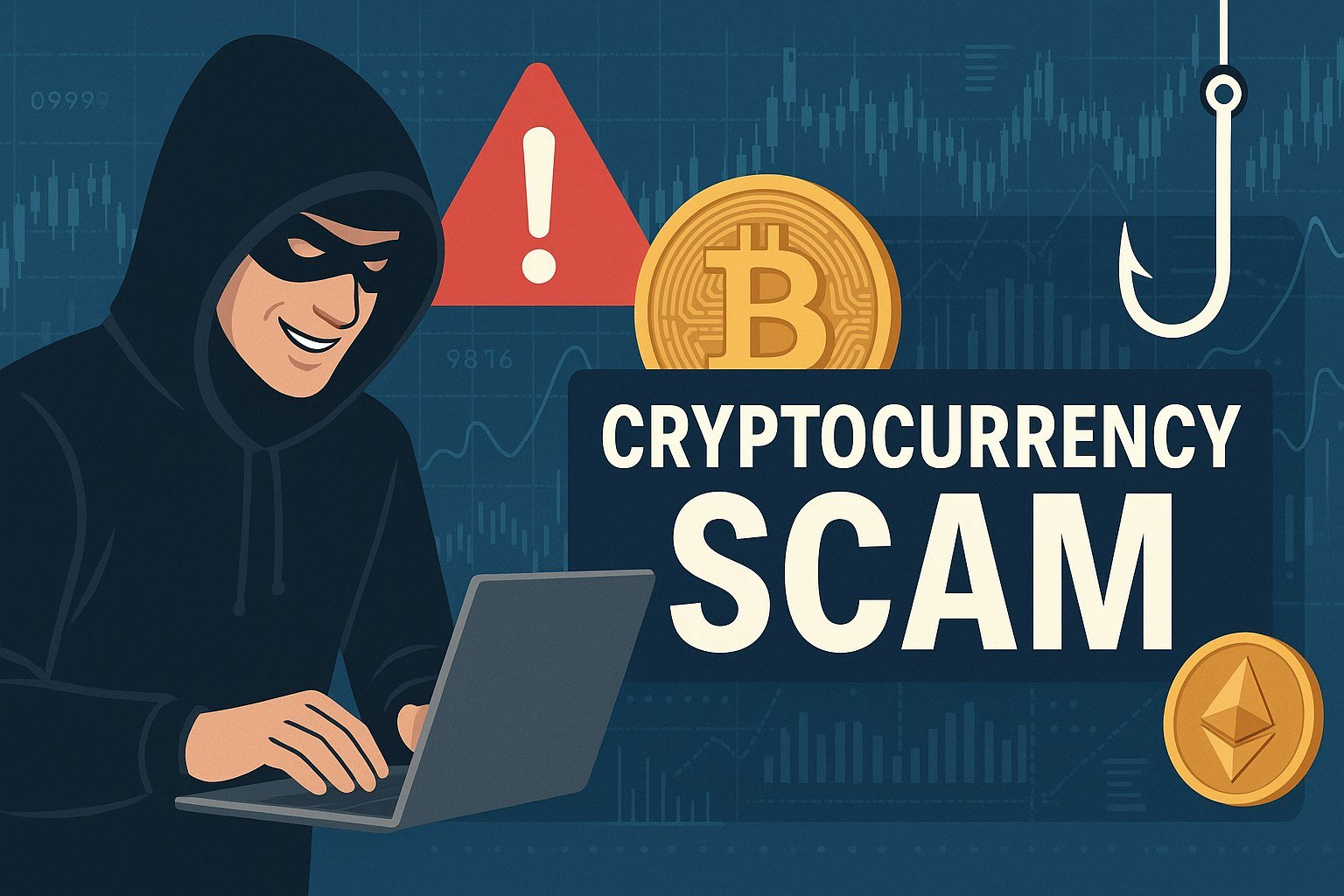
Cryptocurrency has created new opportunities for payments, investing, trading, and decentralized applications. Unfortunately, it has also created new opportunities for scammers.
Crypto transactions can be fast, global, and difficult to reverse. If you send cryptocurrency to the wrong wallet or approve a malicious transaction, recovering the funds may be extremely difficult or impossible.
For beginners, understanding common scams is just as important as learning how cryptocurrency works.
The good news is that many crypto scams follow recognizable patterns. Once you know what to look for, you can significantly improve your ability to identify suspicious offers, fake websites, fraudulent investments, and malicious wallet requests.
In this complete guide, we will explain the most common cryptocurrency scams, how they work, the warning signs to watch for, and practical steps you can take to protect your crypto.
🛡️ Why Crypto Security Matters
Traditional financial systems often provide mechanisms such as:
- Bank fraud departments
- Chargebacks
- Payment reversals
- Account recovery
- Customer support
- Transaction monitoring
Cryptocurrency can work differently.
Depending on the blockchain and transaction type, once a transaction is confirmed, it may not be reversible.
If you accidentally send Bitcoin to the wrong address, for example, the blockchain generally does not provide a simple “cancel” button.
This creates an important principle:
In crypto, prevention is usually much better than recovery.
You should therefore treat your wallet, private keys, recovery phrase, and transaction approvals as extremely important security information.
🚨 What Is a Crypto Scam?
A cryptocurrency scam is a fraudulent scheme designed to steal:
- Cryptocurrency
- Private keys
- Recovery phrases
- Wallet access
- Exchange credentials
- Personal information
- Money
Scammers may use technology, social engineering, fake websites, impersonation, investment promises, or psychological pressure.
Some scams are technically sophisticated.
Others are surprisingly simple.
The most successful scams often rely on one thing:
Getting the victim to trust the scammer.
🎣 1. Phishing Scams
Phishing is one of the most common forms of online fraud.
A scammer creates a fake website, email, message, or social-media account designed to look like a legitimate service.
The goal is to trick you into providing sensitive information or approving a malicious transaction.
Example
You receive a message:
“Your crypto wallet has been suspended. Verify your account immediately.”
The message includes a link.
You click it and arrive at a website that looks like your wallet provider.
You enter your recovery phrase.
The scammer now has the information needed to access the wallet.
🚩 Phishing Warning Signs
Be careful with:
- Urgent messages
- Unexpected login requests
- Fake security alerts
- Strange URLs
- Misspelled domains
- Requests for recovery phrases
- Requests to connect wallets
- “Account verification” messages
🛡️ How to Protect Yourself
Don’t click suspicious links.
Instead:
- Open your browser yourself.
- Enter the official website address manually.
- Verify the domain carefully.
- Log in only through the legitimate platform.
🔑 2. Recovery Phrase Scams
Your recovery phrase is one of the most important pieces of information associated with a non-custodial wallet.
It may consist of a series of words that can be used to restore access to the wallet.
Anyone who obtains it may potentially gain control over the assets associated with that wallet.
🚫 Never Share Your Recovery Phrase
No legitimate support agent should need your recovery phrase to:
- Fix your wallet
- Verify your account
- Recover a transaction
- Unlock your funds
- Activate an airdrop
- Connect your wallet
If someone asks for it, treat the request as a major warning sign.
👨💻 3. Fake Customer Support Scams
Imagine you have a problem with a crypto platform.
You post about it publicly.
A person replies:
“I’m official support. Send me a private message.”
They may ask you for:
- Recovery phrase
- Private key
- Password
- Authentication code
- Wallet connection
- Remote access
They may even use a professional-looking profile.
🛡️ Protection
If you need support, go directly to the platform’s official website and find its support section.
Don’t trust unsolicited messages from people claiming to be support staff.
💰 4. Fake Investment Scams
Investment scams promise unrealistic returns.
For example:
“Invest $500 and receive $1,000 next week.”
Or:
“Our AI crypto trading system guarantees 20% every month.”
These promises should immediately make you suspicious.
🚩 Common Investment Scam Signals
- Guaranteed profits
- Fixed high returns
- “Zero risk”
- Pressure to deposit immediately
- Fake account dashboards
- Fake testimonials
- Fake celebrity endorsements
- Withdrawal fees that appear later
- Referral bonuses
- Limited-time investment opportunities
Real investments involve risk.
A person promising guaranteed cryptocurrency profits is a major warning sign.
📈 5. Ponzi and Pyramid-Style Crypto Schemes
Some fraudulent crypto projects depend primarily on recruiting new investors.
Early participants may receive money, creating the appearance of a successful business.
But the system may depend on a constant flow of new money.
Eventually, if new participants stop arriving, the system can collapse.
Warning Signs
Be suspicious when a project focuses heavily on:
- Recruitment
- Referral commissions
- Guaranteed returns
- Recruiting friends
- Multi-level rewards
- Passive income promises
- Little information about the actual product
Ask:
Where does the money actually come from?
If the answer is mainly “new investors,” that is a serious warning sign.
🎁 6. Fake Giveaway Scams
Giveaway scams are extremely common on social media.
A scammer may pretend to be:
- A cryptocurrency company
- A famous investor
- A blockchain founder
- An exchange
- A celebrity
They may announce:
“Send 1 ETH and receive 2 ETH back.”
The victim sends the cryptocurrency.
The promised payment never arrives.
🚨 Remember
Legitimate giveaways do not need to ask you to send cryptocurrency first in order to receive more cryptocurrency back.
If someone promises to double your crypto, assume it is a scam unless you can independently verify the promotion through a legitimate source.
👤 7. Celebrity Impersonation Scams
Scammers frequently create fake accounts pretending to be well-known people.
They may copy:
- Profile photos
- Usernames
- Bios
- Posts
- Verification-style symbols
- Followers
They then promote:
- Fake investments
- Giveaways
- New tokens
- Fake presales
- Suspicious websites
🛡️ How to Protect Yourself
Don’t trust an account simply because it looks professional.
Check:
- Exact username
- Account history
- Official website
- Verified communication channels
- Whether the same announcement appears on official sources
💕 8. Romance Scams
Romance scams combine emotional manipulation with financial fraud.
A scammer may build a relationship with someone online and eventually introduce cryptocurrency.
They might say:
“I’ve been making money trading crypto. I can teach you.”
Eventually they may encourage the victim to deposit money into a fake investment platform.
The victim sees fake profits on the website.
When they try to withdraw the funds, the scammer demands additional payments.
🚩 Warning Signs
Be especially careful if someone you’ve met online:
- Quickly becomes emotionally attached
- Talks about investments constantly
- Promises easy profits
- Encourages you to use a particular platform
- Asks for cryptocurrency
- Claims they can guarantee returns
Never let emotional trust replace financial due diligence.
💻 9. Fake Crypto Trading Platforms
Some scams create entire fake investment websites.
The website may display:
- Account balance
- Trading charts
- Profits
- Deposits
- Withdrawal options
Everything may look legitimate.
But the displayed balance can simply be numbers controlled by the scammer.
When you attempt to withdraw, they may ask for:
- Taxes
- Verification fees
- Processing fees
- Security deposits
- Unlock fees
You pay the fee, but another fee appears.
This can continue until the victim realizes the entire platform is fraudulent.
🚨 Important Rule
If a platform says:
“Pay us more money to unlock the money already in your account.”
stop and investigate carefully.
🪙 10. Fake Tokens
Anyone can create a token on many blockchain networks.
This makes it possible for scammers to create tokens with:
- Similar names
- Similar logos
- Fake branding
- Fake websites
A scam token may pretend to be associated with a legitimate cryptocurrency.
Example
A scammer could create a token with a name that looks almost identical to a well-known project.
A beginner sees the familiar name and buys it.
Always verify the official contract address through a reliable official source.
Never rely solely on a token’s name or logo.
🎯 11. Rug Pulls
A rug pull occurs when a project’s creators or insiders withdraw liquidity or otherwise exploit the project’s structure, leaving investors with major losses.
Rug pulls can happen in decentralized markets where anyone can create tokens or liquidity pools.
Common Warning Signs
- Anonymous or unverifiable team
- Extreme marketing
- Very high promised returns
- Low liquidity
- Concentrated token ownership
- Unclear tokenomics
- No credible product
- Sudden aggressive promotion
Not every anonymous project is fraudulent, but anonymity can make accountability more difficult.
🐸 12. Meme Coin Scams
Meme coins can become extremely popular.
Some may develop genuine communities and liquidity.
Others may be created primarily for speculation.
The danger increases when people buy solely because:
“Everyone is buying it.”
Watch Out For
- Extreme price spikes
- Celebrity promotion
- Fake community activity
- Concentrated token ownership
- Low liquidity
- Anonymous developers
- Aggressive “100x” marketing
A token rising quickly doesn’t prove that it is legitimate.
🎁 13. Fake Airdrops
Airdrops can distribute tokens to users as part of legitimate crypto projects.
Unfortunately, scammers can use the same concept.
You may suddenly find an unfamiliar token in your wallet.
A website may tell you:
“Connect your wallet to claim your free tokens.”
The malicious website may attempt to get you to sign a transaction or approve token spending.
🛡️ Safe Approach
Don’t interact with random tokens simply because they appear in your wallet.
If you hear about a legitimate airdrop, verify it through the project’s official communication channels.
🧾 14. Malicious Token Approvals
When using decentralized applications, you may sometimes be asked to approve a smart contract to interact with your tokens.
Some approvals can grant significant permissions.
A malicious application may attempt to trick you into approving an unsafe contract.
Before Approving
Ask:
- Do I trust this website?
- Is the contract legitimate?
- What token am I approving?
- What permissions am I granting?
- Is an unlimited approval being requested?
- Do I actually need this approval?
Don’t click “Approve” automatically.
🌐 15. Fake Wallet Apps
Scammers may create fake wallet applications that imitate legitimate wallets.
They may appear in:
- App stores
- Search results
- Advertisements
- Download websites
A fake wallet could attempt to steal:
- Recovery phrases
- Private keys
- Passwords
- Funds
🛡️ Protect Yourself
Download wallets only through trusted official sources.
Verify:
- Official website
- Developer name
- App details
- Download source
- Community documentation
Don’t install a wallet simply because its logo looks familiar.
📱 16. Fake Crypto Apps and Browser Extensions
The same problem can occur with browser extensions and desktop applications.
A malicious extension may attempt to monitor or manipulate transactions.
Before installing an extension:
- Verify the developer
- Check official documentation
- Verify the download source
- Look for suspicious permissions
- Avoid unofficial copies
Security should always come before convenience.
💬 17. Telegram and Discord Scams
Crypto communities frequently use platforms such as Telegram and Discord.
Scammers can enter these communities and pretend to be:
- Administrators
- Moderators
- Developers
- Support agents
They may contact users privately.
🚩 Be Careful If Someone Says:
- “You won a reward.”
- “Send funds to verify your wallet.”
- “Give me your seed phrase.”
- “I can recover your funds.”
- “Connect to this private website.”
- “Pay this fee to unlock your tokens.”
Treat unsolicited private messages with suspicion.
🧑💼 18. Fake Job Scams
Crypto-related job scams can also target people looking for employment.
A scammer may offer:
- Remote jobs
- Crypto trading positions
- Marketing roles
- Community manager positions
- Investment jobs
Then they may request:
- Upfront payments
- Crypto deposits
- Wallet connections
- Personal information
- Fake “training fees”
A legitimate employer generally should not require you to send cryptocurrency simply to receive a job.
📦 19. Fake Mining Scams
Some fraudulent websites promise cryptocurrency mining returns.
They may advertise:
“Deposit $100 and earn $10 every day from cloud mining.”
The website may show fake mining statistics.
Eventually, withdrawals become impossible.
Research Before Paying
Ask:
- Does the company have verifiable mining operations?
- Is the business transparent?
- Where are the mining facilities?
- How does the company generate revenue?
- Are the promised returns realistic?
Never assume a professional website means the business is legitimate.
📞 20. Blackmail and Extortion Scams
Some scammers use threats to pressure victims into sending cryptocurrency.
They may claim:
- They have hacked your device
- They have compromising information
- They will publish private data
- They have access to your accounts
They may demand Bitcoin or another cryptocurrency.
Don’t panic.
Instead:
- Preserve evidence
- Secure your accounts
- Change passwords where appropriate
- Enable strong authentication
- Report the scam to relevant authorities or platforms
Don’t send cryptocurrency simply because someone threatens you.
🔐 How to Protect Your Crypto
Understanding scams is useful, but security habits are even more important.
🛡️ 1. Protect Your Recovery Phrase
Store your recovery phrase securely.
Never:
- Screenshot it
- Email it
- Send it through messaging apps
- Store it in public cloud storage
- Share it with support
- Enter it into random websites
For significant holdings, consider secure offline storage.
🔑 2. Use Strong Passwords
Use unique passwords for important crypto accounts.
Don’t reuse the same password across:
- Exchange accounts
- Social media
- Banking
- Crypto platforms
If one account is compromised, reused passwords can create additional problems.
🔐 3. Enable Two-Factor Authentication
Where supported, enable two-factor authentication.
It can provide an additional layer of protection beyond your password.
Use security-conscious authentication methods and keep backup/recovery options secure.
📧 4. Protect Your Email Account
Your email account can be extremely important because it may be connected to exchange accounts and password recovery.
Secure it with:
- Strong unique password
- Two-factor authentication
- Recovery methods
- Security alerts
Your email security is part of your crypto security.
🧊 5. Consider Cold Storage for Long-Term Holdings
For substantial long-term holdings, some users choose hardware wallets or other offline-oriented storage methods.
The goal is to reduce exposure to online threats.
But hardware wallets still require careful setup and safe recovery-phrase storage.
A hardware wallet is not magic protection against:
- Phishing
- Fake websites
- Malicious transactions
- Social engineering
You still need to verify what you’re signing.
🧪 6. Test Transactions
When sending cryptocurrency to a new address, consider making a small test transaction first.
This can help confirm:
- Correct address
- Correct network
- Correct destination
Blockchain transactions can be irreversible, so careful verification is important.
🔎 7. Check the Network
One common beginner mistake is sending an asset using the wrong network.
Before transferring crypto, confirm:
- Asset
- Network
- Deposit address
- Withdrawal network
- Memo/tag if required
Sending funds using an unsupported network can create serious recovery problems.
🚫 8. Don’t Trust Urgency
Scammers love urgency.
Examples:
“Act within 10 minutes.”
“Your account will be deleted today.”
“This is your final chance.”
“Send funds immediately.”
Urgency is designed to prevent you from thinking.
Take a step back.
Verify independently.
🧠 The “Stop and Verify” Rule
Before making an important crypto transaction, pause.
Ask yourself:
STOP 🛑
S — Stop
Don’t immediately click or send.
T — Think
Why am I being asked to do this?
O — Observe
Check the website, wallet address, contract, and message.
P — Proceed carefully
Only continue when you are confident the transaction is legitimate.
🚩 The Biggest Crypto Scam Warning Signs
Remember these signals:
🚩 Guaranteed profits
🚩 “Risk-free” investment
🚩 Pressure to act immediately
🚩 Requests for seed phrases
🚩 Fake customer support
🚩 Unexpected giveaways
🚩 Celebrity impersonation
🚩 Unknown wallet connections
🚩 Suspicious websites
🚩 Unrealistic APY
🚩 Withdrawal fees to release fake profits
🚩 Requests for cryptocurrency upfront
🚩 “Send crypto and receive double”
🚩 Anonymous investment schemes
🚩 Fake airdrops
One warning sign doesn’t automatically prove fraud.
Several warning signs together should make you extremely cautious.
🔍 How to Verify a Crypto Website
Before connecting your wallet:
Step 1: Check the Domain
Look carefully at the spelling.
Scammers may use domains that differ by only one character.
Step 2: Find the Official Source
Use the project’s official communication channels to locate the correct website.
Step 3: Don’t Trust Search Ads Automatically
Scammers can sometimes use advertising or search-engine tactics to promote fraudulent websites.
Step 4: Check the Contract Address
If interacting with a token or smart contract, verify the contract address using reliable official documentation.
Step 5: Check What Your Wallet Is Asking You to Sign
Never sign blindly.
🧾 What To Do If You Think You’ve Been Scammed
If you believe you have interacted with a scam, act quickly.
If You Shared Your Recovery Phrase
Treat the wallet as compromised.
Move remaining assets to a new secure wallet if possible and appropriate.
Do not continue using the compromised recovery phrase for valuable holdings.
If You Connected to a Suspicious Website
Disconnect the wallet where applicable.
Review token approvals and transaction activity.
Consider revoking suspicious permissions using a reputable tool appropriate for the relevant blockchain.
If You Shared Your Password
Change it immediately.
Also change it anywhere else you reused the same password.
If Your Exchange Account Was Compromised
Contact the exchange through its official support channel and secure the account.
Keep Evidence
Save:
- Transaction hashes
- Wallet addresses
- Website addresses
- Screenshots
- Emails
- Messages
- Usernames
This information may be useful when reporting the incident.
📋 Your Crypto Security Checklist
Use this checklist regularly:
☑️ My recovery phrase is private
☑️ I use unique passwords
☑️ Two-factor authentication is enabled where appropriate
☑️ I verify website URLs
☑️ I don’t trust unsolicited support messages
☑️ I don’t click random crypto links
☑️ I verify token contract addresses
☑️ I read wallet transaction requests
☑️ I verify the blockchain network before sending funds
☑️ I don’t chase guaranteed returns
☑️ I don’t trust random airdrops
☑️ I research projects before investing
☑️ I keep important holdings appropriately secured
☑️ I maintain separate wallets when useful
☑️ I stay skeptical of urgency and hype
🧠 Golden Rules of Crypto Security
If you remember nothing else from this article, remember these rules:
🔐 Rule #1: Never Share Your Recovery Phrase
Not with anyone.
💰 Rule #2: There Is No Guaranteed Crypto Profit
High returns always involve risk.
🎣 Rule #3: Verify Before You Click
Don’t trust unexpected links.
👛 Rule #4: Your Wallet Is Your Responsibility
Understand what you’re signing.
🚨 Rule #5: Don’t Let Anyone Rush You
Scammers benefit when victims act emotionally.
🔎 Rule #6: Research Before Investing
Understand the project, tokenomics, team, and risks.
🧠 Rule #7: If It Sounds Too Good to Be True, Investigate Carefully
Easy money is one of the oldest scam techniques in the world.
❓ Frequently Asked Questions
What is the most common crypto scam?
Phishing, fake investment schemes, impersonation, fraudulent giveaways, fake support, and malicious websites are among the common ways scammers target cryptocurrency users.
Can cryptocurrency transactions be reversed?
Many blockchain transactions are designed to be irreversible once confirmed. Recovery may be difficult or impossible if funds are sent to the wrong address or a scammer.
Should I give my seed phrase to crypto support?
No. Your recovery phrase should remain secret. Anyone asking for it should be treated as suspicious.
Can someone steal crypto without knowing my password?
Potentially, yes. If an attacker obtains a recovery phrase or private key, they may be able to control the associated wallet without knowing the password you normally use on your device.
Are all new crypto coins scams?
No. New projects can be legitimate, but newly launched tokens can carry higher risks. Always research the project, tokenomics, liquidity, team, technology, and security.
Are crypto giveaways real?
Some legitimate promotional campaigns exist, but “send crypto and receive more crypto back” is a classic scam pattern. Verify any giveaway independently through official sources.
Can a hardware wallet prevent scams?
A hardware wallet can improve security against certain online threats, but it cannot protect you if you voluntarily approve a malicious transaction or reveal your recovery phrase.
What should I do if someone claims they can recover my stolen crypto?
Be extremely cautious. Cryptocurrency recovery scams are common, and scammers may demand upfront payments or sensitive wallet information.
Why do scammers use cryptocurrency?
Cryptocurrency can enable fast, global transfers, and many transactions cannot simply be reversed like some traditional payment methods. These characteristics can be attractive to criminals.
🏁 Final Thoughts
Cryptocurrency security is not only about choosing the right wallet or exchange.
It is about developing the right habits.
Scammers constantly change their stories, websites, social-media accounts, and techniques. But the underlying strategy often remains the same:
Create trust → create urgency → get access to money or information.
Your best defense is to slow down and verify.
Before sending cryptocurrency, connecting a wallet, signing a transaction, or investing in a new token, ask:
Who am I trusting?
What exactly am I approving?
Where is my money going?
Can I independently verify this information?
If you cannot answer those questions confidently, don’t proceed.
Crypto can provide useful technology and financial opportunities, but protecting your assets requires constant awareness.
Stay informed. Stay skeptical. Verify before you trust. And never share your recovery phrase. 🔐
⚠️ Disclaimer
This article is provided for educational and informational purposes only. It is not financial, investment, cybersecurity, legal, or tax advice. Cryptocurrency transactions and wallets involve significant risks, and losses may be irreversible. Security practices vary by blockchain, wallet, exchange, and jurisdiction. Always verify information through official sources and seek qualified professional assistance when appropriate.