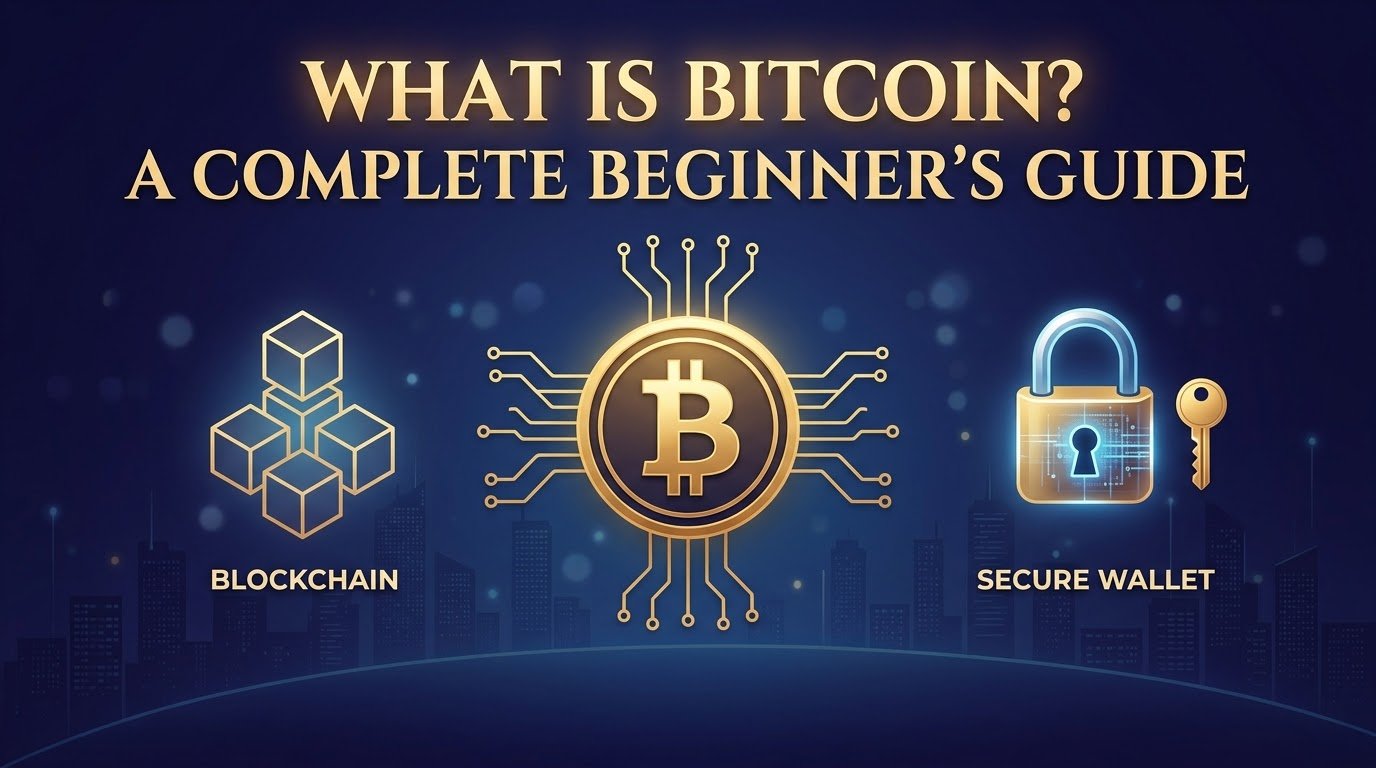
Bitcoin (BTC) is the world’s first major decentralized cryptocurrency. It allows people to send and receive digital value over the internet without depending on a traditional bank to process every transaction.
For beginners, Bitcoin can seem complicated because you may hear terms like blockchain, mining, wallets, private keys, nodes, and cryptocurrency. But once these basic concepts are explained step by step, Bitcoin becomes much easier to understand.
In this guide, we’ll cover everything a beginner should know about Bitcoin, including how it works, why it has value, how transactions happen, what Bitcoin wallets are, how mining works, and how to protect yourself from common crypto scams.
⚠️ Disclaimer: Bitcoin is a highly volatile digital asset. This article is for educational purposes only and should not be considered financial or investment advice.
📌 What Is Bitcoin?
Bitcoin is a digital asset that operates on a decentralized network known as the Bitcoin blockchain.
Unlike traditional currencies such as the US Dollar, Euro, or Pakistani Rupee, Bitcoin isn’t issued and controlled by a central bank.
Instead, Bitcoin operates through a network of computers around the world that follow a common set of rules.
Bitcoin was introduced in 2009 under the name Satoshi Nakamoto.
The main idea was to create a form of digital money that could be transferred directly from one person to another without requiring a bank or centralized financial institution.
💡 Simple Example
With traditional banking:
👤 Person A → 🏦 Bank → 👤 Person B
With Bitcoin:
👤 Person A → ₿ Bitcoin Network → 👤 Person B
The Bitcoin network verifies and records the transaction.
🔗 What Is Blockchain?
To understand Bitcoin, you first need to understand blockchain technology.
A blockchain is a digital record of transactions that is maintained across a network of computers.
You can think of it as a digital public ledger.
When Bitcoin transactions are processed, they are grouped together into collections called blocks.
These blocks are connected to previous blocks, creating a chain.
📦 Block 1 → 📦 Block 2 → 📦 Block 3 → 📦 Block 4
This is where the term blockchain comes from.
Because the records are distributed across the network and protected using cryptography, changing old transaction records is extremely difficult.
🌐 How Does Bitcoin Work?
Bitcoin combines several technologies and processes to operate.
The main components include:
- 🔗 Blockchain
- 💻 Decentralized network
- 🔐 Cryptography
- ⛏️ Mining
- 👛 Wallets
- 🪙 BTC
- 🧾 Transactions
Let’s look at each one.
💻 Bitcoin Is Decentralized
One of Bitcoin’s most important features is decentralization.
There isn’t one company or bank that controls the entire Bitcoin network.
Instead, computers around the world participate in maintaining and verifying the network.
These computers are commonly called nodes.
Nodes help maintain copies of the blockchain and verify whether transactions follow Bitcoin’s rules.
Why Is Decentralization Important?
Imagine a financial system where one central database controls everything.
If that central database fails, gets attacked, or becomes unavailable, the entire system could be affected.
Bitcoin takes a different approach by distributing the network across many computers.
This makes the system less dependent on a single organization.
🪙 What Is BTC?
BTC is the ticker symbol for Bitcoin.
Just as companies and traditional financial assets use symbols, Bitcoin is represented by BTC.
For example:
- Bitcoin = Cryptocurrency
- BTC = Bitcoin’s ticker symbol
You don’t have to purchase one entire Bitcoin.
Bitcoin can be divided into extremely small units.
The smallest unit is called a satoshi.
🧮 1 Bitcoin = 100,000,000 Satoshis
This means someone can own:
- 1 BTC
- 0.5 BTC
- 0.1 BTC
- 0.01 BTC
- 0.001 BTC
- Or much smaller amounts
So, beginners don’t need enough money to purchase one entire Bitcoin.
💰 Why Does Bitcoin Have Value?
This is one of the most common questions beginners ask.
Why does a digital asset have value?
Bitcoin’s market value is influenced by several factors.
🔹 Limited Supply
Bitcoin’s protocol has a maximum supply of approximately 21 million BTC.
This limited supply is one of the characteristics that makes Bitcoin different from currencies whose supply can be changed through monetary policy.
🔹 Demand
Like many assets, Bitcoin’s price is influenced by supply and demand.
When demand increases, buyers may be willing to pay higher prices.
When demand decreases, the price can fall.
🔹 Scarcity
Bitcoin’s limited supply gives it a form of digital scarcity.
Some Bitcoin supporters compare this characteristic with scarce assets such as gold.
However, Bitcoin and gold are different assets and can behave very differently in financial markets.
🔹 Network Effect
Bitcoin has developed a large ecosystem of users, exchanges, wallets, miners, developers, businesses, and other participants.
A larger ecosystem can increase the usefulness and recognition of a network.
⛏️ What Is Bitcoin Mining?
Bitcoin uses a consensus mechanism called Proof of Work.
Mining is the process through which specialized computers help process transactions and secure the Bitcoin network.
The computers involved are operated by miners.
A simplified version of the process looks like this:
👥 Users make transactions
⬇️
💻 Transactions are broadcast to the network
⬇️
⛏️ Miners process transactions
⬇️
📦 Transactions are organized into a block
⬇️
🔗 Block is added to the blockchain
⬇️
✅ Network recognizes the confirmed transaction
Bitcoin mining requires significant computing resources and electricity.
🧮 What Is Proof of Work?
Proof of Work is a system used by Bitcoin to help secure its blockchain.
Miners use computing power to compete in solving a cryptographic challenge.
The miner that successfully produces a valid block can add it to the blockchain, assuming the block follows the network’s rules.
Mining also makes certain attacks on the network expensive because an attacker would need significant computing resources.
👛 What Is a Bitcoin Wallet?
A Bitcoin wallet is a tool used to manage your Bitcoin.
One important concept for beginners is that your Bitcoin isn’t literally sitting inside the wallet.
The Bitcoin is recorded on the blockchain.
Your wallet manages the cryptographic keys that allow you to control your Bitcoin.
A wallet can involve:
- 🔑 Private keys
- 📍 Bitcoin addresses
- ✍️ Transaction signatures
- 🧾 Transaction history
Different types of wallets exist, including software wallets, hardware wallets, and other forms of self-custody solutions.
🔐 What Is a Private Key?
A private key is one of the most important pieces of information in Bitcoin ownership.
It is used to authorize transactions.
If another person obtains the information needed to control your Bitcoin, they may be able to move your funds.
That’s why private keys and recovery phrases must be protected carefully.
🚨 Never Share Your:
- ❌ Private key
- ❌ Seed phrase
- ❌ Recovery phrase
- ❌ Wallet backup information
Never send these details to someone claiming to be customer support.
📍 What Is a Bitcoin Address?
A Bitcoin address is used to receive Bitcoin.
You can think of it somewhat like an email address, although the technology behind it is completely different.
If someone wants to send you Bitcoin, you provide an appropriate Bitcoin address.
The sender enters the address into their wallet and submits the transaction.
⚠️ Always Check the Address
Before sending Bitcoin, carefully verify the destination address.
A mistake can result in permanent loss because Bitcoin transactions generally cannot simply be reversed like a traditional bank transfer.
🏦 What Is a Crypto Exchange?
A cryptocurrency exchange is a platform that allows users to buy, sell, or trade digital assets.
Depending on the platform and your location, you may be able to purchase Bitcoin using:
- 💵 Fiat currency
- 🏦 Bank transfers
- 💳 Supported payment methods
- 🪙 Other cryptocurrencies
Before using an exchange, research its:
- 🔐 Security practices
- 💵 Trading fees
- 🧾 Withdrawal policies
- ⭐ Reputation
- 📜 Regulatory status
- 🌍 Availability in your country
Never deposit money into a platform simply because someone on social media recommended it.
📲 How to Buy Bitcoin
The general process is straightforward.
1️⃣ Choose a Reputable Platform
Research a legitimate cryptocurrency exchange or service available in your country.
2️⃣ Create an Account
You may need to provide identity and other information depending on the platform’s legal requirements.
3️⃣ Secure Your Account
Use a strong password and enable two-factor authentication whenever available.
4️⃣ Deposit Funds
Add money using an available payment method.
5️⃣ Purchase BTC
Select Bitcoin and enter the amount you want to purchase.
6️⃣ Think About Storage
For larger amounts or long-term holdings, learn about self-custody and different wallet options before deciding where to keep your Bitcoin.
📊 Bitcoin Price Volatility
Bitcoin is known for significant price volatility.
Its price can move:
- 📈 Quickly upward
- 📉 Quickly downward
- ↔️ Sideways for extended periods
This means Bitcoin isn’t a guaranteed way to make money.
One of the biggest mistakes beginners make is buying Bitcoin simply because its price has recently increased.
🧠 Don’t Invest Based on Hype
Avoid making financial decisions because:
“Everyone is buying Bitcoin.”
or:
“Bitcoin is going to double tomorrow.”
Crypto markets can change quickly.
Instead, learn the technology, understand the risks, and make decisions based on your own financial circumstances.
🐂 What Is a Bitcoin Bull Market?
A bull market is generally a period in which an asset’s price is trending upward.
During strong cryptocurrency bull markets, Bitcoin can attract significant attention from:
- 👥 Retail investors
- 🏦 Institutions
- 📰 Media
- 💻 Traders
- 🏢 Businesses
Bull markets can create opportunities, but they can also encourage excessive speculation and emotional decision-making.
🐻 What Is a Bitcoin Bear Market?
A bear market generally refers to a period of declining prices or negative market sentiment.
Bitcoin has experienced major price declines throughout its history.
During these periods, investors may become fearful and sell their holdings.
Understanding these market cycles can help beginners realize that cryptocurrency prices don’t move upward forever.
🔄 How Does a Bitcoin Transaction Work?
Let’s imagine that Alice wants to send Bitcoin to Bob.
Step 1: Alice Creates a Transaction
Alice enters Bob’s Bitcoin address and chooses the amount she wants to send.
Step 2: Alice Authorizes the Transaction
Her wallet uses the required cryptographic information to sign the transaction.
Step 3: The Transaction Is Broadcast
The transaction is sent to the Bitcoin network.
Step 4: Nodes Verify It
Bitcoin nodes check whether the transaction follows the network’s rules.
Step 5: A Miner Includes It in a Block
The transaction can be included in a block created by a miner.
Step 6: The Blockchain Records It
Once the block is accepted by the network, the transaction becomes part of the blockchain history.
Step 7: Bob Receives the Bitcoin
Bob’s wallet can recognize the incoming Bitcoin.
⏱️ How Long Does a Bitcoin Transaction Take?
Bitcoin transactions aren’t necessarily confirmed instantly.
Confirmation times can depend on factors such as:
- Network activity
- Transaction fee rate
- Miner activity
- Current blockchain conditions
A transaction can be broadcast before it receives its first confirmation.
For important transactions, users may wait for additional confirmations.
💸 What Are Bitcoin Transaction Fees?
Bitcoin transactions can involve fees.
These fees are generally associated with processing transactions and incentivizing miners.
During periods of high network demand, transaction fees can increase.
Before sending Bitcoin, understand that your total cost may include both:
₿ Amount being sent + Network fee
Different wallets may display fees in different ways.
🛡️ How to Keep Your Bitcoin Safe
Security should be a top priority for every cryptocurrency user.
🔐 Use Strong Passwords
Don’t use simple passwords such as:
123456password- Your name
- Your birthday
Use unique and strong passwords.
📱 Enable Two-Factor Authentication
Two-factor authentication, commonly known as 2FA, adds an additional security layer to your accounts.
🧾 Protect Your Recovery Phrase
Never post your recovery phrase online.
Don’t send it through messaging apps.
Don’t share it with someone who contacts you unexpectedly.
🚫 Avoid Suspicious Links
Crypto scammers frequently create fake websites designed to steal login details or wallet information.
📍 Verify Wallet Addresses
Always double-check the address before confirming a transaction.
💻 Keep Your Devices Secure
Keep your operating system, browser, wallet software, and security tools updated.
🚨 Common Bitcoin Scams
Bitcoin itself is a technology, but scammers often use cryptocurrency to conduct fraud.
Here are some common examples.
❌ Fake Investment Websites
A website may promise guaranteed returns or extremely high daily profits.
Be extremely cautious of guaranteed crypto profits.
❌ Fake Giveaways
A scammer may claim:
“Send Bitcoin and receive double the amount back.”
This is a classic cryptocurrency scam.
❌ Fake Customer Support
Someone may pretend to work for an exchange or wallet company.
They may ask for your password or recovery phrase.
❌ Phishing Websites
A fake website can look almost identical to a legitimate cryptocurrency platform.
Always carefully check the website you’re using.
❌ Ponzi Schemes
Some fraudulent platforms use money from new participants to pay earlier participants until the system collapses.
🚨 Golden Rule
Never give your private key or recovery phrase to anyone.
🌍 Bitcoin vs Traditional Money
Bitcoin and traditional currencies have several important differences.
| Feature | Bitcoin | Traditional Currency |
|---|---|---|
| Central authority | No single central authority | Usually central bank/government |
| Physical form | Digital | Physical and digital |
| Supply | Protocol-defined | Depends on monetary policy |
| Transactions | Blockchain network | Banking/payment systems |
| Volatility | High | Generally lower |
| Self-custody | Possible | Usually depends on financial institutions |
These differences don’t necessarily mean Bitcoin will replace traditional currencies.
They show that Bitcoin represents a different approach to digital value transfer.
⚖️ Advantages of Bitcoin
Bitcoin has several characteristics that attract users around the world.
✅ Decentralization
No single organization controls the entire Bitcoin network.
✅ Digital
Bitcoin is designed for the internet era and exists digitally.
✅ Limited Supply
The protocol has a maximum supply of approximately 21 million BTC.
✅ Transparency
Bitcoin blockchain data can be publicly inspected.
✅ Global Network
The Bitcoin network operates across countries and regions.
✅ Self-Custody
Users can potentially control their Bitcoin directly instead of relying entirely on a financial institution.
⚠️ Disadvantages and Risks
Bitcoin also comes with important risks.
📉 Price Volatility
Bitcoin can experience large price changes.
🔐 Security Responsibility
With self-custody, you are responsible for protecting your keys.
🚫 Irreversible Transactions
Mistaken Bitcoin transactions generally cannot simply be reversed.
🏛️ Regulatory Risk
Cryptocurrency regulations vary between countries and may change over time.
🎣 Scams
Crypto users can become targets for phishing, fraud, fake investments, and other scams.
⚡ Energy Consumption
Bitcoin mining requires substantial computing resources and electricity.
🧠 Bitcoin Myths Beginners Should Know
Myth 1: You Must Buy One Whole Bitcoin
❌ False.
Bitcoin can be divided into very small units called satoshis.
Myth 2: Bitcoin Is Completely Anonymous
❌ Not exactly.
Bitcoin transactions are generally visible on the public blockchain.
Bitcoin is better described as pseudonymous rather than completely anonymous.
Myth 3: Bitcoin Always Goes Up
❌ False.
Bitcoin has experienced significant price declines throughout its history.
Myth 4: Bitcoin Isn’t Real Because It’s Digital
❌ False.
Digital assets can have economic value.
Bitcoin records ownership and transactions through its blockchain network.
Myth 5: Someone Can Recover a Lost Seed Phrase
❌ Usually not.
If you lose the information required to access a self-custodied wallet, recovering the funds may be impossible.
🌟 Why Do People Use Bitcoin?
People use or hold Bitcoin for different reasons.
Some view it as:
- 🪙 A digital asset
- 🌐 A global payment network
- 🔐 A self-custody technology
- 💰 A speculative asset
- 🏦 An alternative financial asset
- 🥇 A potential store of value
Different people can have completely different opinions about Bitcoin’s long-term role.
🔮 What Could Bitcoin’s Future Look Like?
Nobody knows exactly what Bitcoin’s future will look like.
Its development could be influenced by:
- 🌍 Global adoption
- 🏦 Institutional participation
- 🏛️ Government regulations
- 💻 Technology development
- ⚡ Mining economics
- 📈 Market demand
- 🔐 Security
- 🌐 Global economic conditions
Most importantly, nobody can reliably predict Bitcoin’s future price.
Be cautious when someone claims they know exactly where BTC will trade in the future.
📚 How Should Beginners Learn Bitcoin?
If you’re completely new to cryptocurrency, don’t rush into trading.
A better learning path is:
Step 1: Understand Bitcoin
Learn what Bitcoin is and why it was created.
Step 2: Learn Blockchain
Understand how transactions are recorded.
Step 3: Learn Wallets
Understand addresses, private keys, and recovery phrases.
Step 4: Understand Transactions
Learn how Bitcoin moves from one address to another.
Step 5: Learn About Exchanges
Understand fees, security, withdrawals, and account protection.
Step 6: Learn About Scams
Understand phishing, fake investments, and wallet theft.
Step 7: Study Market History
Learn how Bitcoin has behaved during previous market cycles.
Step 8: Make Informed Decisions
Only after learning the basics should you consider whether Bitcoin fits your financial goals and risk tolerance.
📝 Bitcoin Beginner Checklist
Before buying or using Bitcoin, make sure you understand:
- ☑️ What Bitcoin is
- ☑️ What BTC means
- ☑️ What blockchain is
- ☑️ What Bitcoin mining is
- ☑️ What a Bitcoin wallet does
- ☑️ What a private key is
- ☑️ What a recovery phrase is
- ☑️ How Bitcoin transactions work
- ☑️ What transaction fees are
- ☑️ How cryptocurrency scams work
- ☑️ Why Bitcoin is volatile
If you understand these concepts, you have a strong foundation for exploring the wider cryptocurrency industry.
❓ Frequently Asked Questions
What is Bitcoin in simple words?
Bitcoin is a decentralized digital asset and payment network that allows value to be transferred through a blockchain-based system without relying on a single central authority.
Who created Bitcoin?
Bitcoin was introduced in 2009 under the pseudonym Satoshi Nakamoto.
What is BTC?
BTC is the ticker symbol for Bitcoin.
Is Bitcoin a cryptocurrency?
Yes. Bitcoin is generally considered the first major decentralized cryptocurrency.
Can I buy less than one Bitcoin?
Yes. Bitcoin can be divided into very small units called satoshis.
Is Bitcoin safe?
Bitcoin’s network is designed with strong security mechanisms, but using Bitcoin still involves risks such as scams, phishing, compromised devices, lost keys, and market volatility.
Can Bitcoin be hacked?
The Bitcoin network is designed to resist attacks, but individual users can lose funds through phishing, compromised wallets, fraudulent platforms, or poor security practices.
Is Bitcoin legal?
Bitcoin’s legal and regulatory status varies by country and can change over time. Users should check the current laws and regulations applicable to their location.
🎯 Final Thoughts
Bitcoin introduced a new way of thinking about digital money.
Instead of depending entirely on banks or centralized payment companies, Bitcoin uses decentralization, cryptography, blockchain technology, and Proof of Work to maintain a digital monetary network.
For beginners, the most important thing isn’t learning how to make quick profits.
The first priority should be understanding how Bitcoin works and what risks are involved.
A good learning path is:
₿ Bitcoin → 🔗 Blockchain → 👛 Wallets → 🔐 Private Keys → 🧾 Transactions → 🛡️ Security → 📊 Market Risks
Once you understand these fundamentals, you’ll have a much stronger foundation for learning about Ethereum, altcoins, DeFi, crypto trading, and the rest of the cryptocurrency ecosystem.
🚀 Start With Knowledge, Not Hype
Talks Cryptos is designed to make cryptocurrency easier to understand by providing beginner-friendly guides, blockchain education, crypto market updates, trading information, wallet guides, and security tips.
⚠️ Disclaimer: Cryptocurrency markets are highly volatile and involve substantial risk. The information provided in this article is for educational and informational purposes only and does not constitute financial, investment, legal, or tax advice. Always conduct your own research and consider your financial situation before making any cryptocurrency-related decision.