
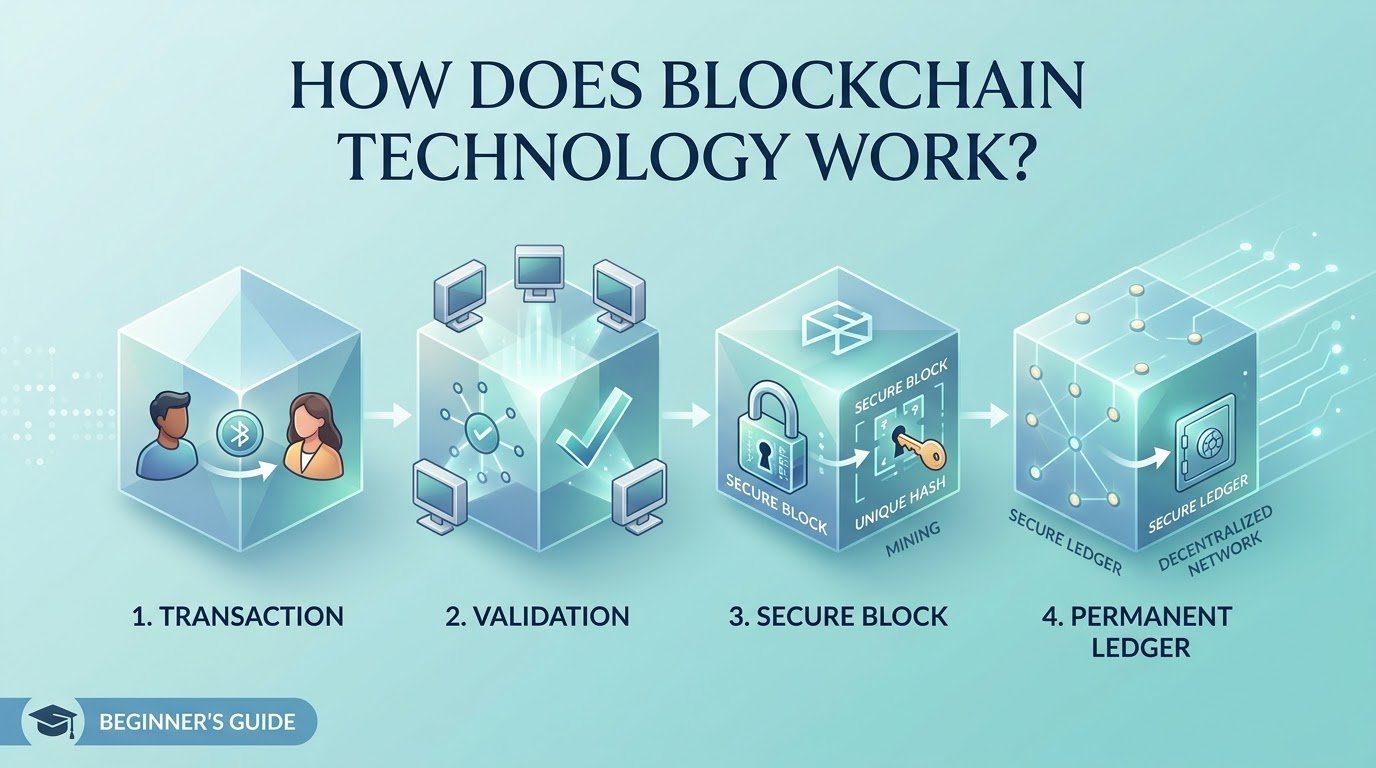
Blockchain technology has become one of the most important technologies behind the modern cryptocurrency industry.
When people hear the word blockchain, they often immediately think about Bitcoin. Bitcoin was indeed the first major application of blockchain technology, but blockchain has developed far beyond cryptocurrency.
Today, blockchain technology is used in areas such as decentralized finance, digital assets, smart contracts, supply-chain systems, tokenization, and many other experiments in digital ownership and coordination.
For beginners, blockchain can sound complicated because it involves terms such as blocks, nodes, cryptography, consensus, miners, validators, wallets, hashes, and smart contracts.
The good news is that the basic idea is much easier than it sounds.
In this guide, we’ll explain what blockchain is, how it works, how transactions are verified, what blocks and nodes do, how Proof of Work and Proof of Stake differ, and why blockchain security matters.
⚠️ Disclaimer: This article is for educational and informational purposes only. Blockchain and cryptocurrency projects can involve technical, financial, security, and regulatory risks.
📌 What Is Blockchain?
A blockchain is a type of distributed digital ledger that records information in a sequence of connected blocks.
In simple terms, imagine a digital record book that:
- 💻 Exists across many computers
- 🔗 Stores information in blocks
- 🔐 Uses cryptography
- 🌐 Is maintained by a network
- ✅ Uses consensus rules to determine valid updates
Instead of one organization maintaining the only copy of the database, a blockchain network can distribute copies of its ledger across many participants.
💡 Simple Example
Imagine 1,000 people each have a copy of the same digital notebook.
Someone wants to add a new transaction.
The network checks whether the transaction follows the rules.
If it is valid, the transaction can be included in a new page.
That page is then connected to the previous pages.
This is a simplified way of understanding how a blockchain works.
🧱 Why Is It Called a Blockchain?
The word has two parts:
Block + Chain
A block contains a collection of transactions or other data.
The chain refers to the way blocks are connected together.
A simplified blockchain might look like:
🧱 Block 1 → 🧱 Block 2 → 🧱 Block 3 → 🧱 Block 4 → 🧱 Block 5
Each block is connected to previous blocks using cryptographic information.
This helps create a chronological history of the blockchain.
📦 What Is a Block?
A block is a package of information added to a blockchain.
The exact contents vary between blockchain networks, but a block may contain information such as:
- 🧾 Transactions
- ⏰ Timestamp-related information
- 🔢 Block-related data
- 🔗 A reference to a previous block
- 🔐 Cryptographic information
- ⛏️ Mining or validator information
The structure differs depending on the blockchain.
Bitcoin blocks, for example, have a particular design and consensus process, while other blockchains may organize their data differently.
🔢 What Is a Hash?
A hash is a cryptographic output generated from data.
You can think of a hash as a type of digital fingerprint.
If the input data changes, the resulting hash will generally change.
For example:
Data A → 🔐 Hash A
If the data changes:
Data B → 🔐 Hash B
This property is useful for detecting changes in blockchain data.
🧠 Simple Analogy
Imagine taking a fingerprint of a document.
If someone changes the document, the fingerprint can change.
Blockchain systems use cryptographic hashing as part of their mechanisms for linking and protecting data.
🔗 How Are Blocks Connected?
One important feature of many blockchains is that each block contains information referencing an earlier block.
A simplified example:
Block 100
contains a reference to:
Block 99
Block 99 references:
Block 98
And so on.
This creates a chain of linked blocks.
If someone tries to change old data, the cryptographic relationships can reveal that something has changed.
This doesn’t mean blockchain data is literally impossible to modify under every circumstance.
Instead, blockchain designs make unauthorized historical changes difficult by combining cryptography, consensus, and distributed verification.
🌐 What Is a Distributed Ledger?
A distributed ledger is a digital record maintained across multiple network participants rather than being controlled by a single database server.
Traditional databases often look like:
👥 Users → 🏢 Central Database
A blockchain network can look more like:
👤 Node
↕️
👤 Node
↕️
👤 Node
↕️
👤 Node
All participating nodes follow the blockchain’s protocol rules.
💻 What Is a Blockchain Node?
A node is a computer that participates in a blockchain network.
Different blockchain networks can have different types of nodes and different responsibilities.
Depending on the network, nodes may:
- 📥 Receive transactions
- ✅ Verify transactions
- 📦 Store blockchain data
- 📡 Share information with other nodes
- 🧾 Validate blocks
- 🌐 Help maintain network connectivity
Nodes are an important part of decentralization.
🔄 How Does a Blockchain Transaction Work?
Let’s imagine Alice wants to send a cryptocurrency to Bob.
The process can be simplified into several stages.
1️⃣ Alice Creates a Transaction
Alice opens her crypto wallet.
She enters Bob’s blockchain address and selects the amount she wants to send.
2️⃣ Alice Signs the Transaction
Her wallet uses cryptographic information to authorize the transaction.
3️⃣ Transaction Is Broadcast
The transaction is sent to the blockchain network.
4️⃣ Nodes Check the Transaction
Network participants check whether the transaction follows the rules.
For example, they may check whether the sender has sufficient funds and whether the transaction has a valid signature.
5️⃣ Transaction Enters the Confirmation Process
Depending on the blockchain, miners or validators participate in deciding which transactions are included in the next block.
6️⃣ Block Is Added
A valid block is added to the blockchain.
7️⃣ Transaction Becomes Confirmed
The transaction becomes part of the blockchain’s recorded history.
🛡️ What Is Consensus?
Consensus is the process through which participants in a distributed network agree on the valid state of the blockchain.
Without consensus, different computers could maintain conflicting versions of the ledger.
Blockchain protocols therefore use specific rules to determine:
- Which transactions are valid
- Which blocks are valid
- Who can add blocks
- How network participants agree
- How dishonest behavior is handled
Different blockchains use different consensus mechanisms.
⛏️ What Is Proof of Work?
Proof of Work (PoW) is the consensus mechanism used by Bitcoin.
Under Proof of Work, miners use computing power to compete to produce valid blocks.
Mining involves solving a computational puzzle according to the blockchain’s rules.
The process requires:
- 💻 Computing hardware
- ⚡ Electricity
- 🌐 Network connectivity
- 🧮 Computational work
The successful miner can add a valid block to the blockchain and receive rewards according to the protocol.
🧑💻 Why Does Bitcoin Use Mining?
Mining helps Bitcoin achieve decentralized consensus.
Instead of having a central company decide which transactions should be added to the ledger, miners compete according to predefined rules.
Proof of Work also makes certain types of attacks expensive because controlling a large amount of mining power requires significant resources.
🪙 What Is Proof of Stake?
Proof of Stake (PoS) is another consensus mechanism used by various blockchain networks.
Instead of relying primarily on computational mining, Proof of Stake generally involves participants committing or staking cryptocurrency according to the protocol’s rules.
These participants can be involved in validating blocks and transactions.
The exact design differs from blockchain to blockchain.
Proof of Work vs Proof of Stake
| Feature | Proof of Work | Proof of Stake |
|---|---|---|
| Main participants | Miners | Validators |
| Main resource | Computing power | Staked assets |
| Electricity requirements | Generally high | Generally lower |
| Example | Bitcoin | Ethereum |
| Security model | Computational work | Economic stake and protocol rules |
This is a simplified comparison because real-world blockchain consensus systems can be much more complex.
🔐 How Does Blockchain Security Work?
Blockchain security comes from multiple mechanisms working together.
These can include:
- 🔒 Cryptography
- 🌐 Decentralization
- 🧮 Consensus
- 🔗 Hashing
- 🔑 Digital signatures
- 👥 Network participation
No single feature makes a blockchain secure.
The security comes from how the entire system is designed.
✍️ What Are Digital Signatures?
Digital signatures are cryptographic mechanisms used to prove that a transaction was authorized by the holder of the relevant private key.
For example:
Private Key → ✍️ Digital Signature → Transaction
Other network participants can verify the signature without needing to know the private key itself.
This is an important part of cryptocurrency security.
🔑 Public Keys and Private Keys
Cryptocurrency systems commonly use public and private cryptographic keys.
🔓 Public Key
A public key can be shared according to the system’s rules and is used as part of the process of identifying or deriving an address.
🔐 Private Key
A private key must be kept secret.
It can be used to authorize transactions.
🚨 Important Rule
Never share your private key or wallet recovery phrase with anyone.
If someone gains control of the relevant private keys, they may be able to move the assets associated with them.
👛 How Do Wallets Work With Blockchain?
A crypto wallet doesn’t literally store cryptocurrency like a physical wallet stores cash.
Instead, it manages the cryptographic keys used to interact with blockchain assets.
A wallet may allow you to:
- 👀 View balances
- 📤 Send assets
- 📥 Receive assets
- ✍️ Sign transactions
- 🔗 Connect to blockchain applications
The blockchain itself maintains the underlying record of ownership or asset balances.
💰 What Is a Blockchain Transaction Fee?
Many blockchains charge fees when users submit transactions.
These fees can serve different purposes depending on the network.
They may:
- 💻 Compensate validators or miners
- 🛡️ Help prevent network abuse
- 📊 Help manage demand for limited block space
Different blockchains use different fee models.
Some transactions can be inexpensive while others can become expensive during periods of high demand.
🚦 What Is Blockchain Congestion?
Blockchain networks have limited processing capacity.
When many users try to submit transactions at the same time, demand can increase.
This can result in:
- ⏳ Longer confirmation times
- 💸 Higher transaction fees
- 📊 Increased competition for block space
The exact effect depends on the blockchain’s design.
Developers continue to work on different scaling technologies to improve blockchain capacity.
📈 What Is Blockchain Scalability?
Scalability refers to a blockchain’s ability to handle increasing numbers of users and transactions while maintaining acceptable performance.
A blockchain needs to balance several factors, including:
- ⚡ Speed
- 💰 Cost
- 🔐 Security
- 🌐 Decentralization
Improving one area can sometimes create trade-offs in another.
This is one of the biggest technical challenges in blockchain development.
🧩 What Are Smart Contracts?
A smart contract is a computer program deployed on a blockchain.
It can automatically execute predefined rules when certain conditions are met.
For example, imagine a simple contract designed to exchange one digital asset for another.
The program could be written to:
Receive Asset A → Check Conditions → Send Asset B
No human employee necessarily needs to manually process every step.
Smart contracts have enabled developers to create blockchain-based applications.
🏦 What Is DeFi?
DeFi, or Decentralized Finance, refers broadly to financial applications built using blockchain technology.
DeFi applications can provide functions such as:
- 💱 Token swaps
- 💰 Lending
- 📊 Trading
- 💧 Liquidity provision
- 🪙 Stablecoin services
- 🏦 Other financial functions
Users often interact with these applications through crypto wallets.
However, DeFi can carry significant risks, including smart-contract bugs, market volatility, liquidity problems, scams, and protocol failures.
🎟️ What Are Blockchain Tokens?
A blockchain can support digital tokens.
A token can represent different things depending on the project.
It may represent:
- 🪙 A digital asset
- 🏦 A governance right
- 🎮 An in-game item
- 💰 A stable-value asset
- 🔑 Access to a service
- 🎨 A digital collectible
Not every token has the same purpose or value.
🖼️ What Are NFTs?
NFT stands for Non-Fungible Token.
An NFT is a blockchain-based token designed to represent a unique item or record.
Unlike interchangeable units such as one BTC being equivalent to another BTC of the same amount, NFTs are designed to have unique identifiers or properties.
NFTs have been used for:
- 🎨 Digital art
- 🎮 Gaming assets
- 🎫 Tickets
- 🧑🎤 Collectibles
- 🌐 Digital identity experiments
- 🏆 Memberships
The usefulness of an NFT depends heavily on the specific project.
🏭 Blockchain Beyond Cryptocurrency
Blockchain technology isn’t limited to cryptocurrency.
People have explored blockchain applications in:
📦 Supply Chains
Blockchain can potentially provide shared records about products moving through supply chains.
🎫 Ticketing
Blockchain-based tickets can potentially create digital records of ownership or access.
🪪 Digital Identity
Some projects explore blockchain-based identity systems.
🎮 Gaming
Blockchain technology can be used to represent digital game assets.
🏦 Financial Services
Financial institutions have explored blockchain and distributed-ledger applications.
🌐 Tokenization
Real-world or digital assets can potentially be represented through blockchain-based tokens.
Not every blockchain application becomes commercially successful, so individual projects need to be evaluated carefully.
🔍 Is Blockchain the Same as Bitcoin?
No.
This is a very common beginner misunderstanding.
Bitcoin
Bitcoin is a cryptocurrency and blockchain network.
Blockchain
Blockchain is a broader technology and data-structure concept.
A simple way to think about it is:
Blockchain = Technology
Bitcoin = One major application of that technology
However, Bitcoin’s blockchain has its own specific design and rules.
🆚 Blockchain vs Traditional Database
A blockchain and a traditional database are not the same thing.
| Feature | Blockchain | Traditional Database |
|---|---|---|
| Control | Can be decentralized | Usually centralized |
| Data structure | Often blocks/linked records | Tables or other structures |
| Consensus | Network protocol | Database administrator/system |
| Modification | Designed to make unauthorized history changes difficult | Authorized users can usually modify records |
| Performance | Can have scalability trade-offs | Often highly optimized |
| Transparency | Can be public depending on design | Usually controlled access |
Blockchain isn’t automatically better than a traditional database.
The right technology depends on the problem being solved.
🤔 Why Use Blockchain Instead of a Database?
Blockchain can make sense when multiple parties need to share a record without completely trusting one central authority.
Potential advantages include:
- 🌐 Shared infrastructure
- 🔗 Verifiable transaction history
- 🛡️ Tamper resistance
- 👥 Distributed participation
- 🔐 Cryptographic verification
- 🤖 Programmable transactions
But if one trusted organization already controls a system and high performance is the priority, a traditional database may be simpler and more efficient.
⚠️ Blockchain Limitations
Blockchain technology has several limitations.
📉 Scalability
Some blockchains struggle to process large numbers of transactions efficiently.
💸 Fees
Transaction costs can increase during periods of high demand.
⚡ Energy Use
Proof-of-Work systems can consume substantial electricity.
🧑💻 Complexity
Blockchain technology can be difficult for beginners to understand.
🔐 User Responsibility
Self-custody requires users to protect their keys.
🚨 Smart Contract Risks
A bug in a smart contract can potentially result in financial losses.
🏛️ Regulatory Uncertainty
Blockchain and cryptocurrency regulations vary between countries.
🚨 Common Blockchain Scams
Blockchain technology itself isn’t a scam, but scammers can build fraudulent projects around it.
Be careful with:
❌ Guaranteed Profit Schemes
No legitimate blockchain technology guarantees enormous investment returns.
❌ Fake Tokens
Scammers can create tokens that imitate popular projects.
❌ Fake Airdrops
You may be asked to connect your wallet to a malicious website.
❌ Fake Support
Someone may pretend to help you recover your wallet.
❌ Phishing
Fake websites can attempt to steal passwords or wallet information.
❌ Ponzi Schemes
Some fraudulent crypto projects depend on continuously attracting new money.
🛡️ How to Stay Safe
If you interact with blockchain networks, follow basic security practices.
🔐 Protect Your Private Keys
Never share them.
📝 Protect Your Recovery Phrase
Store it securely and privately.
🔗 Check URLs
Before connecting your wallet, verify that you’re using the legitimate website.
🧪 Research Smart Contracts
If you’re interacting with a new project, learn about its contract and security history.
🚫 Don’t Trust Guaranteed Returns
High guaranteed returns are a major warning sign.
👀 Verify Before Signing
Wallets can ask you to approve transactions or permissions.
Read what you’re signing whenever possible.
🧠 Blockchain Terms Beginners Should Know
🔗 Blockchain
A distributed digital ledger containing records.
📦 Block
A collection of blockchain data.
🔐 Hash
A cryptographic output that acts somewhat like a digital fingerprint.
💻 Node
A computer participating in a blockchain network.
⛏️ Miner
A participant that helps secure a Proof-of-Work network.
🧑💻 Validator
A participant that helps validate transactions or blocks under certain consensus mechanisms.
🔑 Private Key
Secret cryptographic information used to authorize transactions.
📍 Address
A blockchain identifier used for receiving or interacting with assets.
✍️ Digital Signature
Cryptographic proof used to authorize a transaction.
🏦 Smart Contract
A blockchain-based program that executes predefined logic.
⛓️ Consensus
The process used by network participants to agree on valid blockchain state.
💰 Gas Fee
A term commonly used for transaction fees on certain smart-contract networks.
❓ Frequently Asked Questions
What is blockchain in simple words?
Blockchain is a type of digital ledger that records information in a distributed network using cryptographic and consensus mechanisms.
Is blockchain the same as cryptocurrency?
No.
Cryptocurrency is one major use of blockchain technology, but blockchain can have other applications.
Who controls a blockchain?
It depends on the blockchain.
Some are highly decentralized, while others may have more centralized control or governance.
Can blockchain data be changed?
Blockchain systems are generally designed to make unauthorized changes to historical records difficult. However, the exact properties depend on the network’s design and governance.
Is blockchain secure?
Blockchain technology can provide strong security mechanisms, but no system is completely risk-free.
Security depends on the protocol, implementation, network participants, applications, and user behavior.
What is Proof of Work?
Proof of Work is a consensus mechanism in which miners use computational resources to help secure the network and produce valid blocks.
What is Proof of Stake?
Proof of Stake is a consensus mechanism where participants generally stake assets to participate in validating the network according to its protocol.
What is a smart contract?
A smart contract is a program deployed on a blockchain that executes predefined rules.
Does every blockchain use mining?
No.
Some blockchains use Proof of Work, while others use Proof of Stake or different consensus mechanisms.
Can blockchain be hacked?
A blockchain network may be exposed to various attacks depending on its design. In addition, applications, exchanges, wallets, and smart contracts can have vulnerabilities even when the underlying blockchain itself is functioning correctly.
🎯 Final Thoughts
Blockchain technology provides a new way of storing and verifying digital information across a distributed network.
At its core, the concept involves:
📦 Blocks → 🔗 Cryptographic Links → 💻 Network Nodes → 🛡️ Consensus → 📚 Shared Ledger
Bitcoin demonstrated how this technology could be used to create a decentralized digital currency.
Other blockchain networks have expanded the concept by supporting smart contracts, tokens, decentralized applications, and financial protocols.
However, blockchain isn’t a magic solution for every problem.
It has real advantages, but it also comes with challenges involving scalability, cost, security, complexity, regulation, and user responsibility.
For anyone entering the cryptocurrency world, understanding blockchain is one of the most important first steps.
Once you understand how blocks, nodes, wallets, transactions, mining, validators, and consensus work, you’ll have a much stronger foundation for understanding Bitcoin, Ethereum, DeFi, NFTs, and other blockchain technologies.
🚀 Learn the Technology Before Following the Hype
Talks Cryptos helps beginners understand cryptocurrency and blockchain through simple educational guides, market information, security tips, and practical explanations.
⚠️ Disclaimer: Cryptocurrency and blockchain-related activities can involve substantial financial and technical risks. This article is provided for educational purposes only and does not constitute financial, investment, legal, or tax advice. Always conduct your own research before making financial decisions.