
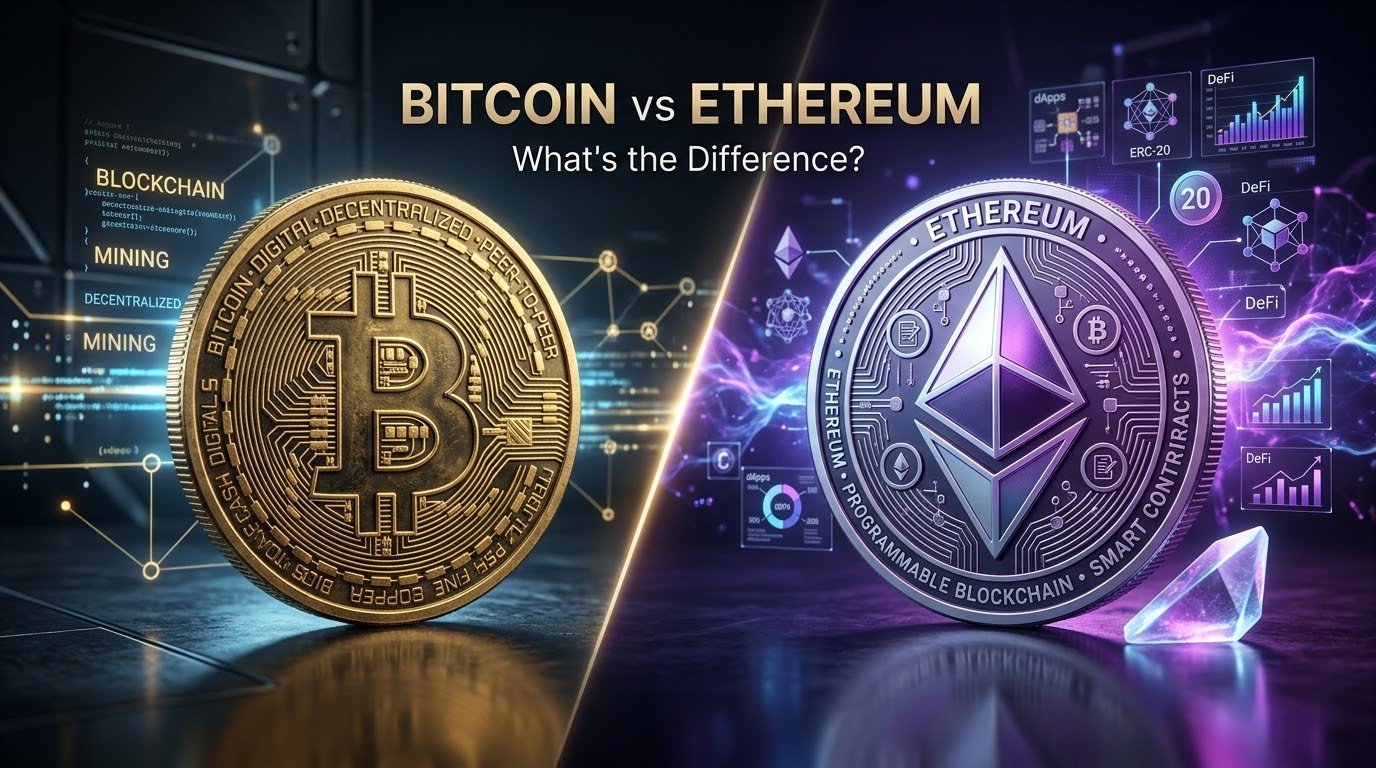
Bitcoin and Ethereum are two of the most well-known names in the cryptocurrency industry. Both use blockchain technology, both have valuable digital assets, and both have attracted millions of users and investors around the world. However, Bitcoin and Ethereum are designed for very different purposes.
Bitcoin was created primarily as a decentralized digital form of money and a way to transfer value without relying on banks or governments. Ethereum, on the other hand, was designed as a programmable blockchain that allows developers to build applications, smart contracts, tokens, decentralized finance platforms, games, and much more.
For beginners, understanding the difference between Bitcoin and Ethereum is important because these two networks represent two different ideas about what blockchain technology can accomplish.
In this guide, we will compare Bitcoin and Ethereum in simple terms, explain how each network works, discuss their differences, advantages, disadvantages, use cases, and help you understand why both remain important in the crypto ecosystem.
📌 Bitcoin vs Ethereum at a Glance
| Feature | Bitcoin | Ethereum |
|---|---|---|
| Launch Year | 2009 | 2015 |
| Main Asset | BTC | ETH |
| Primary Purpose | Digital money / store of value | Programmable blockchain |
| Creator | Satoshi Nakamoto | Vitalik Buterin and contributors |
| Blockchain | Bitcoin blockchain | Ethereum blockchain |
| Consensus | Proof of Stake | Proof of Stake |
| Smart Contracts | Limited | Major feature |
| Decentralized Apps | Limited | Extensive ecosystem |
| Supply | Maximum 21 million BTC | No fixed maximum supply |
| Common Use | Payments, savings, store of value | DeFi, NFTs, apps, smart contracts |
| Transaction Fees | Bitcoin network fees | Ethereum gas fees |
| Market Identity | Digital gold | Programmable blockchain / digital infrastructure |
🟠 What Is Bitcoin?
Bitcoin is the first successful decentralized cryptocurrency. It was introduced in 2009 by an individual or group using the pseudonym Satoshi Nakamoto.
The main idea behind Bitcoin was simple but revolutionary: people should be able to transfer value electronically without needing a central bank, payment company, or other central authority to approve every transaction.
Traditional money systems generally depend on institutions such as banks and payment processors. Bitcoin uses a decentralized network of computers and blockchain technology to maintain a shared record of transactions.
💡 Bitcoin’s Main Goal
Bitcoin was primarily designed to function as:
- 🪙 Digital money
- 💰 A store of value
- 🌍 A global payment network
- 🔐 A decentralized financial asset
- 🏦 An alternative to traditional financial systems
Bitcoin is often compared to digital gold because many investors view it as a scarce asset that can potentially preserve value over long periods.
🟣 What Is Ethereum?
Ethereum is a blockchain platform launched in 2015. It introduced a broader vision for blockchain technology.
Instead of focusing mainly on transferring money, Ethereum was designed to allow developers to create programmable agreements and applications.
Ethereum’s native cryptocurrency is called Ether, commonly represented by ETH.
ETH is used to pay transaction fees on the Ethereum network and can also be used within applications built on Ethereum.
💡 Ethereum’s Main Goal
Ethereum is designed to provide infrastructure for:
- 🤖 Smart contracts
- 💰 Decentralized finance
- 🎨 NFTs
- 🏦 Decentralized applications
- 🪙 Token creation
- 🎮 Blockchain games
- 🏗️ Decentralized organizations
- 🌐 Web3 applications
This makes Ethereum more like a programmable blockchain platform than simply a digital currency.
🔍 Bitcoin vs Ethereum: The Biggest Difference
The easiest way to understand the difference is this:
Bitcoin primarily focuses on decentralized money and value transfer.
Ethereum focuses on programmable blockchain infrastructure.
Think of Bitcoin as a specialized financial network.
Think of Ethereum as a programmable platform where developers can build many different types of blockchain-based applications.
For example, someone might use Bitcoin to send BTC from one wallet to another.
On Ethereum, a user might interact with a decentralized exchange, lend cryptocurrency, purchase an NFT, use a blockchain game, or execute a smart contract.
Both networks use blockchain technology, but their objectives are different.
⚙️ How Bitcoin Works
Bitcoin transactions are recorded on the Bitcoin blockchain.
When someone sends BTC, the transaction is broadcast to the Bitcoin network. Network participants verify the transaction according to Bitcoin’s rules.
Historically, Bitcoin has used Proof of Work as its consensus mechanism.
In Proof of Work, miners use computing power to compete to add new blocks to the blockchain.
Bitcoin’s system is designed around scarcity and security.
There will never be more than 21 million BTC according to Bitcoin’s protocol.
This limited supply is one of the major reasons Bitcoin is often described as a scarce digital asset.
⛏️ Bitcoin Mining
Bitcoin mining involves specialized computers performing computational work to secure the network and process blocks.
Miners compete to solve computational challenges.
The successful miner can add a new block and receive rewards according to the protocol’s rules.
Bitcoin mining has become a highly specialized industry, often involving:
- Specialized ASIC hardware
- Large amounts of electricity
- Mining facilities
- Cooling systems
- Mining pools
- Significant capital investment
The mining process helps secure Bitcoin’s blockchain while introducing new BTC into circulation according to its issuance schedule.
⚙️ How Ethereum Works
Ethereum operates differently.
Ethereum transitioned from Proof of Work to Proof of Stake in 2022.
Under Proof of Stake, validators participate in securing the network by staking ETH.
Instead of relying on large amounts of computational work, Ethereum’s consensus mechanism uses staked ETH and validator participation.
Validators help confirm transactions and maintain the blockchain.
Users can interact with Ethereum through wallets and applications.
For example, a user might:
- Connect a crypto wallet.
- Visit a decentralized application.
- Approve a transaction.
- Pay an Ethereum network fee.
- Have a smart contract execute an action.
- Receive the result on the blockchain.
This programmability is one of Ethereum’s defining characteristics.
🤖 What Are Smart Contracts?
Smart contracts are programs stored and executed on a blockchain.
They can automatically perform actions when predefined conditions are met.
For example, imagine a simple decentralized lending application.
A smart contract could contain rules such as:
If a user deposits collateral and meets the required conditions, allow the user to borrow an asset.
There does not necessarily need to be a traditional intermediary manually approving every transaction.
Smart contracts are one of Ethereum’s most important innovations.
They have enabled entire categories of blockchain applications, including:
- 💰 DeFi
- 🎨 NFTs
- 🏦 Lending platforms
- 🔄 Decentralized exchanges
- 🎮 Blockchain games
- 🪙 Stablecoins
- 🏛️ DAOs
Bitcoin has scripting capabilities, but Ethereum was specifically designed to support more general-purpose smart contracts.
💰 BTC vs ETH
BTC and ETH are the native assets of their respective networks.
🟠 BTC
BTC is Bitcoin’s native cryptocurrency.
It is commonly used for:
- Holding value
- Sending payments
- Investment
- Trading
- Long-term savings
- Institutional exposure
🟣 ETH
ETH is Ethereum’s native cryptocurrency.
It is commonly used for:
- Paying Ethereum transaction fees
- Staking
- Trading
- DeFi applications
- Collateral
- Payments
- Interacting with smart contracts
This means ETH has a broader role inside its blockchain ecosystem.
🏦 Bitcoin as Digital Gold
Bitcoin’s limited supply is one of its most recognizable characteristics.
The Bitcoin protocol has a maximum supply of 21 million coins.
This scarcity has led many people to compare Bitcoin to gold.
Gold has historically been valued partly because it is scarce, durable, difficult to produce, and globally recognized.
Bitcoin attempts to create similar scarcity in digital form.
Why Some Investors Like Bitcoin
Supporters often point to:
- 🔒 Limited supply
- 🌍 Global accessibility
- 🏦 No central issuer
- 🔐 Self-custody
- 📈 Long-term adoption
- 🧱 Network security
- 💻 Digital portability
However, Bitcoin remains a highly volatile asset, and scarcity does not guarantee that its market price will always increase.
🌐 Ethereum as a Digital Platform
Ethereum is often compared to a digital infrastructure layer.
Developers can build applications on top of Ethereum rather than creating an entirely new blockchain from scratch.
For example, Ethereum has been used as infrastructure for:
- Stablecoins
- DeFi protocols
- NFT marketplaces
- Tokenized assets
- Blockchain games
- DAOs
- Web3 applications
This gives Ethereum a very different role in the crypto ecosystem.
Bitcoin asks:
How can we create decentralized digital money?
Ethereum asks:
What can we build if agreements and applications can run on a decentralized blockchain?
⛽ Bitcoin Fees vs Ethereum Gas Fees
Both Bitcoin and Ethereum charge transaction fees, but their systems and usage patterns differ.
Bitcoin Transaction Fees
Bitcoin fees are generally influenced by factors such as:
- Network demand
- Block space availability
- Transaction size
- User-selected fee rate
When demand for Bitcoin block space increases, users may pay higher fees to get transactions confirmed sooner.
Ethereum Gas Fees
Ethereum uses the term gas to describe the computational resources required to execute transactions and smart contracts.
Simple transactions generally require less computational work than complex smart-contract interactions.
For example:
A basic ETH transfer may require relatively little computation.
Interacting with a complicated decentralized application may require substantially more computation.
Ethereum fees therefore depend not only on transferring ETH but also on what users are asking the blockchain to execute.
🪙 Bitcoin Supply vs Ethereum Supply
Another important difference concerns supply.
Bitcoin Supply
Bitcoin has a maximum supply of:
21 million BTC
This is built into Bitcoin’s protocol.
New BTC enters circulation through the block reward system.
Over time, the amount of new BTC created per block decreases through scheduled halving events.
Ethereum Supply
Ethereum does not have the same fixed maximum supply of 21 million.
ETH’s supply dynamics are influenced by factors such as:
- Issuance
- Validator rewards
- Network activity
- ETH burned through the protocol’s fee mechanism
As a result, Ethereum’s supply behavior is more dynamic.
This distinction is important when comparing the monetary properties of BTC and ETH.
🔐 Security: Bitcoin vs Ethereum
Security is one of the most important aspects of any cryptocurrency network.
Bitcoin has operated since 2009 and has developed a large decentralized mining ecosystem.
Ethereum has also developed a large global validator network following its transition to Proof of Stake.
Both networks have substantial economic value secured by their protocols.
However, users should remember that blockchain security does not eliminate all risks.
A cryptocurrency user can still lose funds through:
- 🔑 Lost private keys
- 🎣 Phishing attacks
- 🦠 Malware
- 💻 Compromised devices
- 🚨 Fake websites
- 🤥 Scams
- ❌ Fraudulent smart contracts
The underlying blockchain can be secure while an individual user’s wallet or application is compromised.
🧑💻 Bitcoin vs Ethereum for Developers
Ethereum has a significant advantage for developers who want to build decentralized applications.
Ethereum provides an environment where developers can write smart contracts and deploy them on the blockchain.
Popular smart-contract development commonly involves languages and tools such as:
- Solidity
- Ethereum Virtual Machine
- Web3 libraries
- Development frameworks
- Wallet integrations
Bitcoin development has a different focus.
Bitcoin developers generally work closer to the core protocol, payments, security, scaling solutions, and Bitcoin-focused applications.
This doesn’t mean Bitcoin cannot support innovation.
It means the two ecosystems have historically emphasized different types of development.
🎨 NFTs: Bitcoin vs Ethereum
NFTs, or non-fungible tokens, became strongly associated with Ethereum.
Ethereum’s smart-contract capabilities made it possible for developers to create token standards and applications for unique digital assets.
NFTs can represent:
- Digital artwork
- Collectibles
- Memberships
- Gaming assets
- Tickets
- Digital certificates
Bitcoin has also developed its own ecosystem for digital assets, including systems that use Bitcoin’s blockchain to represent various types of data and assets.
Therefore, NFTs and digital collectibles are no longer exclusively associated with Ethereum.
💰 DeFi: Bitcoin vs Ethereum
DeFi, short for decentralized finance, is one of Ethereum’s strongest areas.
DeFi applications attempt to provide financial services through smart contracts rather than traditional intermediaries.
Examples include:
- Lending
- Borrowing
- Decentralized trading
- Liquidity provision
- Stablecoins
- Derivatives
- Yield-related applications
Ethereum became one of the primary foundations for this ecosystem because developers could create programmable financial applications.
Bitcoin’s primary architecture is more focused on secure money and settlement.
Bitcoin can participate in broader DeFi ecosystems through various technologies and layers, but Ethereum remains one of the most important smart-contract platforms.
⚡ Bitcoin vs Ethereum: Speed
People often compare Bitcoin and Ethereum based on transaction speed.
However, speed isn’t the only factor that matters.
A blockchain must balance:
- Security
- Decentralization
- Scalability
- Cost
- Reliability
Bitcoin prioritizes a conservative approach focused heavily on security and decentralization.
Ethereum has evolved its architecture and ecosystem to support a wider range of applications and scaling solutions.
As blockchain technology develops, both ecosystems continue to improve.
📊 Bitcoin vs Ethereum: Which Is More Popular?
Bitcoin generally has the strongest recognition among the general public.
It was the first major cryptocurrency and remains the most recognizable digital asset.
Ethereum has developed a massive ecosystem around applications and smart contracts.
A simple way to think about their identities is:
Bitcoin = decentralized digital money
Ethereum = programmable blockchain infrastructure
Both are major parts of the cryptocurrency industry.
🟢 Advantages of Bitcoin
Bitcoin offers several characteristics that attract users and investors.
1. Limited Supply
Bitcoin’s maximum supply of 21 million creates digital scarcity.
2. Strong Brand Recognition
Bitcoin is widely recognized as the original cryptocurrency.
3. Long Operating History
Bitcoin has been operating since 2009.
4. Decentralization
Bitcoin is designed to operate without a central company controlling the network.
5. Store-of-Value Narrative
Many investors consider Bitcoin a long-term digital asset.
6. Simple Core Purpose
Bitcoin’s primary purpose is relatively straightforward compared with more complex blockchain ecosystems.
🔴 Disadvantages of Bitcoin
Bitcoin also has limitations.
⚠️ Price Volatility
BTC can experience significant price fluctuations.
⚠️ Energy Requirements
Bitcoin’s Proof-of-Work mining system requires substantial energy.
⚠️ Limited Programmability
Bitcoin is less flexible than Ethereum for general-purpose smart contracts.
⚠️ Transaction Capacity
Bitcoin’s base layer is intentionally designed with conservative limits.
⚠️ User Responsibility
Self-custody means users must protect their private keys and wallet security.
🟢 Advantages of Ethereum
Ethereum’s major strengths include:
1. Smart Contracts
Developers can build programmable applications.
2. Large Developer Ecosystem
Ethereum has a large community of developers and projects.
3. DeFi Infrastructure
Many decentralized financial applications use Ethereum or Ethereum-compatible systems.
4. Token Creation
Developers can create digital tokens using Ethereum-based standards.
5. NFTs
Ethereum helped establish a large ecosystem for NFTs and digital collectibles.
6. Broad Utility
ETH is not only an investment asset but also a functional asset used within the network.
🔴 Disadvantages of Ethereum
Ethereum also has challenges.
⚠️ Complexity
Ethereum’s ecosystem can be difficult for beginners to understand.
⚠️ Smart Contract Risks
Poorly designed smart contracts can contain vulnerabilities.
⚠️ Gas Fees
Network demand can cause transaction costs to increase.
⚠️ Scams
The open nature of token creation makes it easy for fraudulent projects to appear.
⚠️ Technical Risk
Users interacting with decentralized applications must understand wallet permissions and smart-contract risks.
🤔 Should You Choose Bitcoin or Ethereum?
There is no universal answer.
The better choice depends on what you are trying to accomplish.
If You Are Interested in Digital Scarcity
Bitcoin may be more aligned with your goal.
If You Want to Use DeFi
Ethereum may be more relevant.
If You Want a Digital Store of Value
Bitcoin is commonly considered for this purpose.
If You Want to Explore Web3 Applications
Ethereum offers a broad ecosystem.
If You Want to Build Blockchain Applications
Ethereum’s programmable infrastructure may be more suitable.
Remember that choosing a cryptocurrency should not be based solely on popularity.
Always consider:
- Project purpose
- Technology
- Security
- Adoption
- Fees
- Liquidity
- Development activity
- Regulatory environment
- Your own risk tolerance
📈 Bitcoin vs Ethereum as Investments
Bitcoin and Ethereum are both highly speculative digital assets.
Their prices can be affected by:
- Market sentiment
- Global economic conditions
- Regulation
- Institutional demand
- Network developments
- Investor speculation
- Liquidity
- Cryptocurrency market cycles
Bitcoin’s investment narrative often centers around scarcity and store-of-value characteristics.
Ethereum’s investment narrative often includes both ETH’s monetary properties and the potential value generated by Ethereum’s blockchain ecosystem.
Neither narrative guarantees future returns.
Past performance should never be treated as proof of future performance.
🔎 Bitcoin vs Ethereum: What Should Beginners Understand?
If you’re completely new to cryptocurrency, don’t worry about understanding every technical detail immediately.
Start with these five ideas:
🟠 Bitcoin
Bitcoin is primarily designed as decentralized digital money.
🟣 Ethereum
Ethereum is a programmable blockchain platform.
💰 BTC
BTC is Bitcoin’s native asset.
💎 ETH
ETH is Ethereum’s native asset.
🔗 Blockchain
Both use blockchain technology to maintain decentralized records.
Once you understand these five concepts, most other cryptocurrency terminology becomes much easier.
🧠 Common Misconceptions About Bitcoin and Ethereum
Myth 1: Ethereum Is Just Another Cryptocurrency
Not exactly.
ETH is a cryptocurrency, but Ethereum itself is a blockchain platform and ecosystem.
Myth 2: Bitcoin Has No Real Use
Bitcoin can be used for transferring value, holding an asset, and participating in a decentralized financial network.
Myth 3: Ethereum Will Replace Bitcoin
There is no certainty that one will replace the other.
They have different primary purposes.
Myth 4: Bitcoin Is Completely Anonymous
Bitcoin transactions are generally pseudonymous rather than fully anonymous. Blockchain transactions can be publicly visible and analyzed.
Myth 5: Ethereum Transactions Are Always Cheap
Ethereum transaction costs can vary depending on network activity and the type of transaction being executed.
❓ Frequently Asked Questions
Is Bitcoin better than Ethereum?
Not necessarily. Bitcoin and Ethereum serve different purposes. Bitcoin focuses primarily on decentralized money and scarcity, while Ethereum provides programmable blockchain infrastructure.
Is Ethereum better than Bitcoin?
Not necessarily. Ethereum has broader programmability, while Bitcoin has a simpler monetary purpose and a fixed maximum supply.
Can Bitcoin and Ethereum coexist?
Yes. They already coexist as major cryptocurrency networks with different designs and ecosystems.
Which is safer, Bitcoin or Ethereum?
Both networks have strong security models, but users can still lose money through scams, phishing, compromised wallets, and application vulnerabilities.
Can Ethereum be mined?
Ethereum’s main network no longer uses Proof of Work mining. It uses Proof of Stake, where validators participate in network security by staking ETH.
Does Bitcoin have smart contracts?
Bitcoin supports scripting and certain programmable transaction conditions, but its scripting environment is intentionally more limited than Ethereum’s general-purpose smart-contract environment.
Is ETH the same thing as Ethereum?
No.
Ethereum is the blockchain network.
ETH is the native cryptocurrency used by that network.
Is BTC the same thing as Bitcoin?
BTC is the ticker symbol for Bitcoin.
Bitcoin refers to both the network and its native cryptocurrency, depending on context.
Which one should beginners buy?
There is no universally correct choice. Beginners should first understand the technology, risks, fees, custody options, and their own investment objectives before buying any cryptocurrency.
🏁 Final Verdict: Bitcoin vs Ethereum
Bitcoin and Ethereum are two different approaches to blockchain technology.
Bitcoin introduced a decentralized digital monetary system with a strict maximum supply and a strong store-of-value narrative.
Ethereum expanded the blockchain concept by making it programmable, allowing developers to build decentralized applications, smart contracts, financial systems, tokens, games, and other blockchain-based services.
The easiest comparison is:
🟠 Bitcoin is primarily focused on decentralized money.
🟣 Ethereum is primarily focused on programmable blockchain applications.
Neither network needs to completely replace the other.
Bitcoin can continue serving as a decentralized digital asset and monetary network, while Ethereum can continue providing infrastructure for programmable applications.
For anyone entering cryptocurrency, understanding this difference is an excellent starting point.
The crypto industry is much larger than Bitcoin and Ethereum, but these two networks provide an important foundation for understanding how decentralized digital assets and blockchain applications work.
⚠️ Important Crypto Disclaimer
This article is for educational and informational purposes only. It is not financial, investment, legal, or tax advice.
Cryptocurrency markets are highly volatile and can result in substantial losses. Before buying, selling, or investing in BTC, ETH, or any other digital asset, conduct your own research and consider speaking with a qualified financial professional.
Never invest money you cannot afford to lose.