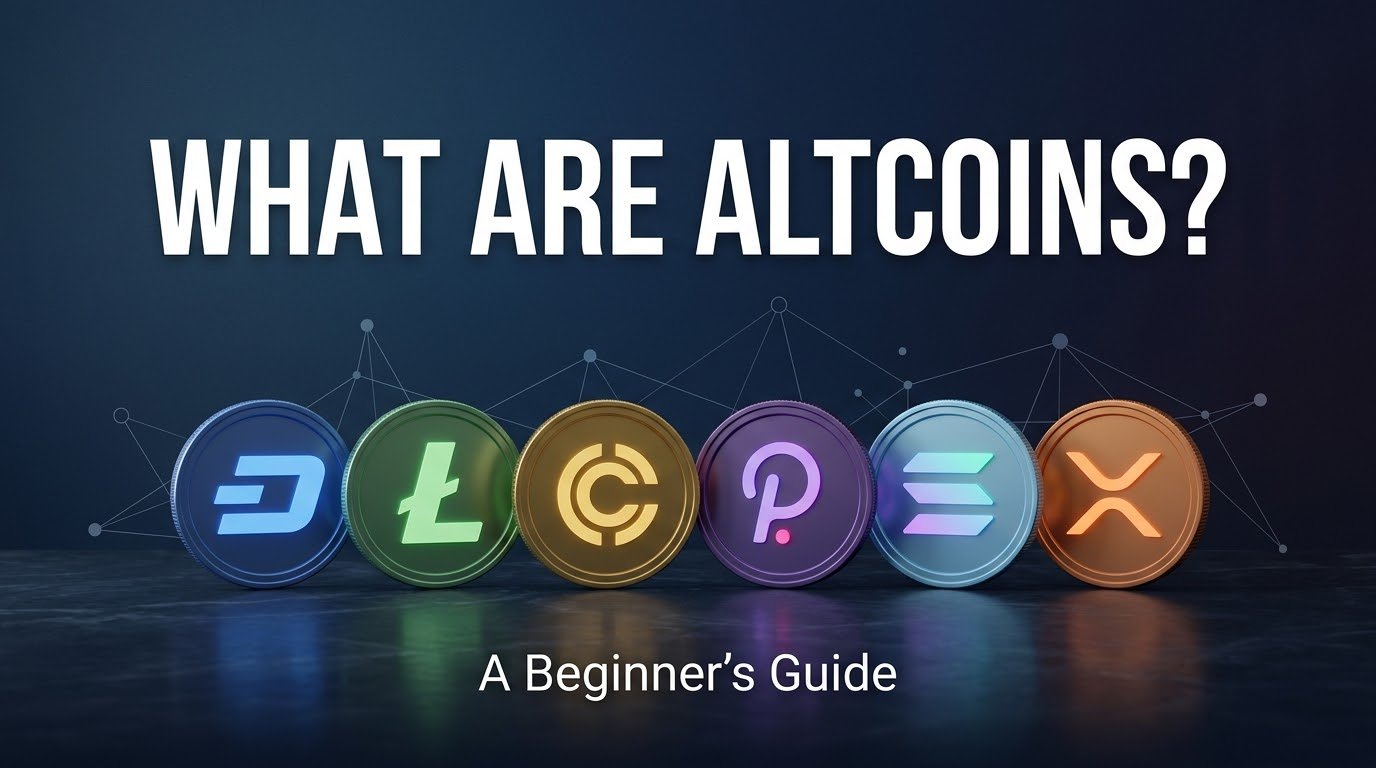
Cryptocurrency is much bigger than Bitcoin. While Bitcoin is the first and most widely recognized cryptocurrency, thousands of other digital assets have been created since its launch.
These cryptocurrencies are commonly called altcoins.
The word altcoin comes from “alternative coin,” meaning a cryptocurrency that is considered an alternative to Bitcoin. Some altcoins attempt to improve blockchain technology, while others are designed for specific applications such as decentralized finance, gaming, payments, privacy, smart contracts, or digital infrastructure.
For beginners, the world of altcoins can be exciting but also confusing. There are thousands of projects, different blockchain networks, different token types, and significant differences in risk.
Some cryptocurrencies have established ecosystems and large communities. Others are experimental projects. Some tokens may have genuine utility, while others may exist mainly because of speculation or hype.
In this guide, we will explain what altcoins are, how they work, the major types of altcoins, popular examples, how to research them, their advantages and risks, and how beginners can avoid common mistakes.
📌 What Is an Altcoin?
An altcoin is generally any cryptocurrency other than Bitcoin.
The term originally became popular when new cryptocurrencies started appearing after Bitcoin.
Early altcoins often attempted to modify Bitcoin’s design.
For example, developers experimented with:
- ⚡ Faster transaction times
- 🔐 Different security models
- ⛏️ Different mining systems
- 🪙 Different coin supplies
- 🕵️ Greater privacy
- 💻 More advanced blockchain functionality
Today, the term “altcoin” is used much more broadly.
It can refer to cryptocurrencies that are completely different from Bitcoin in terms of technology, purpose, and economics.
Some altcoins are native assets of their own blockchains, while others are tokens built on existing blockchain networks.
🧠 Altcoin vs Cryptocurrency
These two terms are related but aren’t exactly identical.
Cryptocurrency is the broad category.
Altcoin generally refers to a cryptocurrency other than Bitcoin.
For example:
- Bitcoin = Cryptocurrency
- Ethereum = Cryptocurrency and commonly considered an altcoin
- Solana = Cryptocurrency and altcoin
- XRP = Cryptocurrency and altcoin
- Cardano = Cryptocurrency and altcoin
The exact use of the term “altcoin” can vary depending on the context.
In everyday crypto discussions, however, it usually means any major cryptocurrency other than Bitcoin.
🟠 Why Were Altcoins Created?
Bitcoin introduced decentralized digital money, but developers soon began asking:
What else can blockchain technology do?
Different teams wanted to solve different problems.
Some wanted faster transactions.
Others wanted smart contracts.
Some focused on privacy.
Others wanted decentralized applications or financial systems.
This experimentation led to the creation of many different blockchain networks and digital assets.
Altcoins therefore represent a wide range of ideas rather than one single technology.
🔗 How Do Altcoins Work?
Altcoins can work in very different ways.
Some have their own blockchain.
Others operate as tokens on another blockchain.
For example, a cryptocurrency can be created on an existing smart-contract network rather than developing a completely new blockchain.
Depending on the project, an altcoin may use:
- ⛏️ Proof of Work
- 🏦 Proof of Stake
- 🔐 Other consensus mechanisms
- 🌐 Independent blockchain infrastructure
- 🤖 Smart contracts
- 🪙 Token standards
- ⚡ Layer-2 technology
Because of this variety, you should never assume that all altcoins operate like Bitcoin.
🧩 Coin vs Token: What’s the Difference?
One of the most important concepts for beginners is understanding the difference between a coin and a token.
🪙 What Is a Coin?
A coin generally refers to a cryptocurrency that operates on its own blockchain.
Examples include:
- Bitcoin on Bitcoin
- Ether on Ethereum
- SOL on Solana
- ADA on Cardano
The blockchain’s native asset is typically used to pay transaction fees and support the network.
🎟️ What Is a Token?
A token is generally an asset created on top of an existing blockchain.
For example, developers can create tokens using smart-contract platforms.
Tokens can represent:
- Digital assets
- Utility
- Governance rights
- Stable-value assets
- In-game items
- Memberships
- Other forms of digital ownership
This distinction isn’t always used perfectly consistently in casual crypto conversations, but it is useful for understanding blockchain ecosystems.
🌐 Major Types of Altcoins
Altcoins can be divided into different categories based on their purpose.
Let’s explore some of the most important ones.
1. 🧠 Smart Contract Platforms
Some altcoins are native assets of blockchain networks designed to support smart contracts and decentralized applications.
Examples include:
- Ethereum
- Solana
- Cardano
- Avalanche
- Polkadot
These networks allow developers to build applications on top of blockchain infrastructure.
Their ecosystems can include:
- DeFi
- NFTs
- Games
- Stablecoins
- Decentralized exchanges
- Governance systems
2. 💵 Stablecoins
Stablecoins are digital assets designed to maintain a relatively stable value compared with an underlying reference asset, commonly the U.S. dollar.
Examples include various dollar-linked tokens.
Stablecoins are widely used in crypto markets for:
- Trading
- Transfers
- Payments
- DeFi
- Moving funds between exchanges
- Holding digital dollars within blockchain ecosystems
However, stablecoins still have risks involving reserves, issuers, regulations, smart contracts, and market conditions.
3. 💰 Payment-Focused Cryptocurrencies
Some cryptocurrencies are designed primarily for payments and transfers.
The goal may be to provide:
- Faster transactions
- Lower fees
- Global transfers
- Alternative payment infrastructure
Different projects approach this problem in different ways.
4. 🕵️ Privacy-Focused Cryptocurrencies
Privacy-focused cryptocurrencies attempt to provide stronger transaction privacy than traditional public blockchains.
Depending on the design, privacy technologies may attempt to hide or obscure:
- Transaction amounts
- Sender information
- Receiver information
- Transaction relationships
Privacy technology is a complicated area, and users should research the technical design and regulatory environment of any privacy-focused asset.
5. 🏦 DeFi Tokens
DeFi means Decentralized Finance.
DeFi projects attempt to provide financial services through blockchain-based systems.
DeFi tokens can be associated with:
- Decentralized exchanges
- Lending platforms
- Borrowing protocols
- Liquidity systems
- Governance
- Derivatives
- Other financial applications
Some DeFi tokens give holders governance rights, while others have different utility.
6. 🎮 Gaming and Metaverse Tokens
Blockchain gaming projects can use cryptocurrencies or tokens for:
- In-game economies
- Digital items
- Rewards
- Marketplace transactions
- Governance
Some projects also use NFTs to represent digital items.
However, gaming tokens can be highly speculative, especially when their value depends heavily on user growth and market enthusiasm.
7. 🤖 AI-Related Crypto Projects
AI and cryptocurrency have increasingly overlapped.
Some crypto projects focus on areas such as:
- Decentralized computing
- Data marketplaces
- AI infrastructure
- Machine learning networks
- Decentralized storage
- AI-agent ecosystems
The combination of AI and blockchain is an evolving field, so investors should distinguish genuine technological utility from marketing hype.
📊 Popular Altcoins
The altcoin market changes over time, but several assets have become well-known because of their networks, ecosystems, market capitalization, or adoption.
Examples include:
🟣 Ethereum — ETH
Ethereum is a programmable blockchain platform.
ETH is used for:
- Transaction fees
- Staking
- DeFi
- Applications
- Smart contracts
🟢 Solana — SOL
Solana is a blockchain platform designed for high-throughput applications.
Its ecosystem includes:
- DeFi
- NFTs
- Consumer applications
- Trading
- Payments
- Other Web3 projects
🔵 Cardano — ADA
Cardano is a blockchain platform that focuses on smart contracts and decentralized applications.
ADA is the network’s native asset.
🟦 XRP
XRP is associated with the XRP Ledger, which focuses heavily on payments and transfers.
🟡 Avalanche — AVAX
Avalanche is a blockchain platform designed to support decentralized applications and customized blockchain environments.
🟣 Polkadot — DOT
Polkadot focuses on interoperability and communication between blockchain networks.
These examples illustrate how different altcoins can have very different goals.
📈 Why Do People Buy Altcoins?
There are several reasons people become interested in altcoins.
🚀 Growth Potential
Some investors believe smaller projects may have greater growth potential than established cryptocurrencies.
However, higher potential returns generally come with higher risk.
A small cryptocurrency can potentially rise rapidly, but it can also lose most or all of its value.
💡 Technology
Some people buy or use cryptocurrencies because they believe the underlying technology could become important.
For example, a blockchain might provide infrastructure for:
- Payments
- Finance
- Gaming
- AI
- Digital identity
- Data
- Decentralized applications
🌐 Ecosystem Participation
Some tokens are required to interact with applications within their ecosystem.
For example, users may need a blockchain’s native asset to pay transaction fees.
🗳️ Governance
Some crypto projects allow token holders to participate in governance.
Depending on the protocol, holders may vote on proposals involving:
- Protocol upgrades
- Treasury spending
- Fees
- Ecosystem decisions
- Other parameters
Governance structures vary significantly between projects.
⚠️ Why Are Altcoins Risky?
Altcoins can be considerably more volatile than established assets.
A cryptocurrency can experience:
📈 A rapid price increase
followed by
📉 A dramatic price decline.
Some altcoins may eventually become inactive or disappear entirely.
Common Risks Include:
- Extreme volatility
- Low liquidity
- Project failure
- Security vulnerabilities
- Smart-contract exploits
- Regulatory changes
- Exchange delisting
- Token supply inflation
- Insider selling
- Market manipulation
- Fake projects
- Phishing scams
- Rug pulls
This is why research is extremely important.
🚨 What Is a Rug Pull?
A rug pull is a type of crypto scam or malicious project behavior in which people behind a project extract funds from users or abandon the project after attracting investment.
A typical scenario might look like this:
- 🚀 A new token is launched.
- 📢 Social media promotion begins.
- 👥 Influencers or anonymous accounts promote it.
- 💰 People buy the token.
- 📈 The price rises.
- 🏃 Insiders sell or remove liquidity.
- 📉 The token crashes.
Not every rapidly falling token is a rug pull, but investors should be especially careful with anonymous teams, unrealistic promises, concentrated token ownership, and suspicious liquidity arrangements.
🔍 How to Research an Altcoin
Before buying an altcoin, research more than its price.
A low price does not automatically mean a cryptocurrency is cheap.
Likewise, a high price does not automatically mean it is expensive.
Here are the factors beginners should examine.
1. 🎯 Understand the Purpose
Ask:
What problem is this project trying to solve?
If you cannot explain the project’s purpose in simple language, take more time to research it.
2. 👨💻 Research the Team
Find out:
- Who created the project?
- Are the developers known?
- Do they have relevant experience?
- Are they actively developing?
- Is there transparent communication?
An anonymous team doesn’t automatically mean a project is fraudulent, but it can make due diligence more difficult.
3. 📖 Read the Documentation
Look for:
- Whitepaper
- Technical documentation
- Roadmap
- Token information
- Governance documentation
- Security information
Don’t rely only on social media posts.
4. 💰 Understand Market Capitalization
Market capitalization is generally calculated as:
Price × circulating supply
For example, if a token trades at $2 and has 10 million circulating tokens:
$2 × 10,000,000 = $20 million market capitalization
Market cap provides more useful context than token price alone.
🧮 Market Cap vs Token Price
Consider two hypothetical cryptocurrencies.
Coin A
Price = $0.10
Circulating supply = 10 billion
Market cap = $1 billion
Coin B
Price = $100
Circulating supply = 1 million
Market cap = $100 million
Even though Coin B has a much higher individual token price, its total market capitalization is smaller.
This is why statements like:
“This coin is only $0.10, so it must be cheap.”
can be misleading.
Always examine supply and market capitalization.
🪙 Understand Token Supply
Tokenomics is one of the most important areas to research.
Look at:
- Circulating supply
- Total supply
- Maximum supply
- Inflation
- Unlock schedules
- Team allocations
- Investor allocations
- Treasury holdings
- Staking rewards
A project may have a low circulating supply today but plan to release many more tokens later.
This can increase selling pressure.
🔓 What Are Token Unlocks?
Token unlocks occur when previously restricted tokens become available to certain holders.
These holders could include:
- Founders
- Employees
- Early investors
- Venture capital firms
- Ecosystem participants
Large unlocks can potentially increase the amount of tokens available for sale.
Therefore, investors should examine the project’s token unlock schedule where available.
📊 Liquidity Matters
Liquidity refers broadly to how easily an asset can be bought or sold without causing a large price movement.
A cryptocurrency with low liquidity can be dangerous for traders.
For example, suppose a token appears to have a market value of millions of dollars but has very little actual trading liquidity.
A relatively large sell order could cause the price to fall dramatically.
Before trading smaller altcoins, check:
- Trading volume
- Order-book depth
- Exchange availability
- Liquidity pools
- Bid-ask spreads
🏦 Exchange Listings
Where an altcoin trades can matter.
Major exchanges generally have listing requirements and risk controls, although exchange listing is not a guarantee that a project is safe or successful.
Smaller tokens may only be available on decentralized exchanges or lesser-known platforms.
Always verify that you are using the legitimate website or exchange.
Scammers frequently create fake exchange pages and fake token contracts.
🔐 Wallet Security for Altcoins
If you hold altcoins, wallet security becomes extremely important.
Follow basic security practices:
🔑 Protect Your Seed Phrase
Never share your recovery phrase with anyone.
Not with:
- Friends
- Online support
- Telegram administrators
- Discord moderators
- “Investment managers”
- Fake customer service representatives
A legitimate service should not need your wallet recovery phrase.
🛡️ Use Strong Security
Consider:
- Strong passwords
- Two-factor authentication
- Hardware wallets for significant holdings
- Separate wallets for different activities
- Regular software updates
🚫 Avoid Suspicious Links
Don’t connect your wallet to random websites sent through social media messages.
A malicious smart contract can potentially cause serious financial damage.
📱 Social Media and Altcoins
Social media plays a huge role in cryptocurrency markets.
Platforms such as X, Telegram, Discord, YouTube, and other communities can spread information extremely quickly.
This can be useful for discovering projects.
But it can also create enormous amounts of hype.
Be careful with phrases such as:
🚀 “Guaranteed 100x”
💎 “Zero risk”
🔥 “Next Bitcoin”
💰 “Easy millionaire strategy”
⏰ “Buy before it’s too late”
These statements are marketing signals, not proof of investment quality.
🧠 Don’t Buy an Altcoin Just Because It’s Trending
A token becoming popular online doesn’t necessarily mean it is valuable.
Prices can increase because of:
- Social media hype
- Influencers
- Speculation
- Market momentum
- Celebrity attention
- Exchange listings
- News
- Short-term trading
But hype can disappear just as quickly.
A strong research process should examine the project beyond its current popularity.
🐸 Meme Coins: Are They Altcoins?
Meme coins are generally cryptocurrencies created around internet culture, memes, communities, or viral trends.
Examples have included various dog-themed and internet-themed tokens.
Meme coins can attract enormous attention.
However, many are extremely speculative.
Their prices can be influenced heavily by:
- Social media
- Community sentiment
- Influencers
- Viral trends
- Large holders
- Liquidity
- Market psychology
If you’re considering meme coins, understand that their risks can be significantly different from those of established blockchain networks.
📉 Why Altcoins Can Crash So Quickly
Altcoins can experience dramatic declines because of several factors.
Low Liquidity
There may not be enough buyers when investors want to sell.
Large Holder Selling
Whales or insiders may hold substantial portions of supply.
Market Panic
When Bitcoin falls sharply, altcoins can sometimes experience even larger declines.
Project Problems
Security incidents, development issues, or regulatory problems can hurt confidence.
Token Unlocks
Newly released supply can create additional selling pressure.
Loss of Hype
If investors lose interest, trading activity can fall rapidly.
🐋 What Is a Crypto Whale?
A whale is generally a person, organization, or wallet that holds a large amount of a cryptocurrency.
Whales can have a significant effect on smaller markets.
If a small group controls a large percentage of the circulating supply, investors should pay attention to concentration.
A highly concentrated token can carry additional risks because large holders may have substantial influence over price and governance.
🛠️ Fundamental Analysis of Altcoins
Before investing, try to evaluate an altcoin from several perspectives.
Technology
Does the technology actually work?
Adoption
Are people using the network or application?
Developers
Is the development team active?
Community
Is the community genuine and engaged?
Tokenomics
Is the token supply sustainable?
Competition
What other projects solve the same problem?
Security
Has the project experienced hacks or major vulnerabilities?
Liquidity
Can users realistically buy and sell the asset?
Transparency
Does the project clearly explain its goals and risks?
This process can help you avoid making decisions based solely on price charts.
📚 Altcoin Research Checklist
Before buying an altcoin, consider asking:
☑️ What does the project do?
☑️ What problem does it solve?
☑️ Who is building it?
☑️ Is the technology working?
☑️ How many users does it have?
☑️ What is the market cap?
☑️ What is the circulating supply?
☑️ What is the total supply?
☑️ Are more tokens being unlocked?
☑️ Who owns the tokens?
☑️ How liquid is the market?
☑️ Where can it be traded?
☑️ Has the project experienced security problems?
☑️ What are its competitors?
☑️ What could cause the project to fail?
☑️ What could cause the token price to fall?
If you cannot answer these questions, you may need more research before making a decision.
📈 Altcoins and Bitcoin Market Cycles
Altcoins often behave differently depending on the broader cryptocurrency market.
During strong market periods, investors may move from larger cryptocurrencies into smaller projects seeking higher returns.
This can create periods of strong altcoin performance.
But the opposite can also happen.
During market downturns, investors may reduce exposure to higher-risk assets.
Because altcoins generally have higher risk profiles, their declines can sometimes be significantly larger.
This is one reason experienced investors pay attention to the overall market rather than analyzing a single token in isolation.
⚖️ Diversification and Altcoins
Holding several cryptocurrencies does not automatically create proper diversification.
For example, holding ten different altcoins doesn’t necessarily mean your portfolio has ten independent sources of risk.
Many cryptocurrencies can be strongly correlated with the overall crypto market.
A market-wide decline can therefore affect many holdings simultaneously.
Investors should understand correlation, concentration, and overall portfolio risk.
🚨 Common Altcoin Scams
Beginners should know the most common scams.
Fake Airdrops
Scammers may promise free tokens and ask users to connect their wallets.
Fake Presales
Fraudsters may advertise a token that doesn’t actually exist or has no legitimate development team.
Fake Support
Someone may contact you pretending to be exchange or wallet support.
Phishing Websites
A website may look almost identical to a legitimate platform but secretly steal login details or wallet information.
Pump-and-Dump Schemes
A group may promote a token aggressively to push the price higher before selling into the demand they created.
Fake Giveaways
Scammers may claim that users will receive more cryptocurrency after sending an initial amount.
A simple rule is:
Never send cryptocurrency to someone simply because they promise to send more back.
🏁 Are Altcoins Worth Considering?
Altcoins can be an important part of the cryptocurrency ecosystem.
They have introduced innovations in:
- Smart contracts
- Decentralized finance
- Payments
- Gaming
- Digital assets
- Governance
- Blockchain interoperability
- Decentralized infrastructure
- AI-related applications
However, the large number of projects also creates significant risk.
Not every altcoin will succeed.
Some will fail because of poor technology.
Others may fail because of weak adoption, competition, regulation, security problems, or unsustainable economics.
The goal shouldn’t be to find the token that someone claims will “100x.”
The better approach is to understand what you’re buying and what could go wrong.
❓ Frequently Asked Questions
What is an altcoin?
An altcoin is generally a cryptocurrency other than Bitcoin.
Is Ethereum an altcoin?
Yes. Ethereum is commonly classified as an altcoin because it is a cryptocurrency and blockchain network other than Bitcoin.
Are all altcoins risky?
No two altcoins have exactly the same risk profile, but cryptocurrencies outside Bitcoin can carry substantial risks, particularly smaller or less-established projects.
Are altcoins better than Bitcoin?
There is no universal answer. Altcoins and Bitcoin often serve different purposes.
What is the safest altcoin?
There is no cryptocurrency that can be guaranteed to be safe. Even established projects can experience volatility, technical problems, regulatory changes, or market declines.
How do I know if an altcoin is legitimate?
Research its team, technology, documentation, tokenomics, development activity, community, liquidity, security history, and actual use.
Can an altcoin go to zero?
Yes. A cryptocurrency can lose most or all of its market value.
Why are some altcoins so cheap?
Usually because they have large token supplies. A low individual token price does not necessarily mean a cryptocurrency is undervalued.
What is tokenomics?
Tokenomics refers to the economic design of a cryptocurrency or token, including supply, distribution, issuance, unlocks, utility, and incentives.
Should beginners invest in small altcoins?
Beginners should understand the risks before considering small-cap cryptocurrencies. Smaller projects can have much higher volatility and liquidity risk.
🎯 Final Thoughts
Altcoins have transformed the cryptocurrency industry from a single digital currency into a massive ecosystem of blockchain networks, applications, tokens, and financial technologies.
Some altcoins focus on smart contracts.
Others focus on payments.
Some support decentralized finance.
Others explore gaming, AI, privacy, interoperability, or decentralized infrastructure.
This diversity creates opportunities for technological innovation, but it also creates enormous risk.
For beginners, the most important lesson is:
Don’t judge an altcoin by its price alone.
A token priced at $0.01 is not automatically cheaper than a token priced at $100.
Look at:
- Market capitalization
- Token supply
- Utility
- Adoption
- Development
- Liquidity
- Security
- Competition
- Team
- Token unlocks
- Overall market conditions
Most importantly, don’t allow social media hype to replace research.
The cryptocurrency market rewards knowledge but can punish careless decisions very quickly.
Take your time, understand the technology, protect your wallet, and never invest more than you can afford to lose.
⚠️ Important Crypto Disclaimer
This article is for educational and informational purposes only. It is not financial, investment, legal, or tax advice.
Cryptocurrency and altcoin markets are highly volatile. Smaller cryptocurrencies can experience extreme price movements and may become illiquid or lose most or all of their value.
Always conduct your own research before buying or trading any cryptocurrency. Consider consulting a qualified financial professional for advice based on your individual circumstances.
Never invest money you cannot afford to lose.